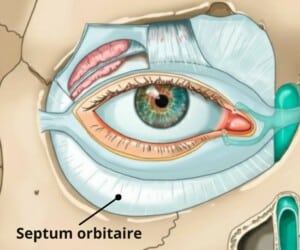
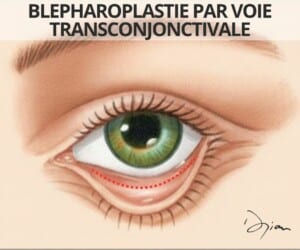
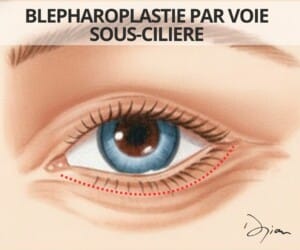

In the following lines, you'll discover how a precise examination of your face allows you to decide between these options, taking into account your expectations, your vision and your daily life.

Your Questions
FREQUENTLY ASKED QUESTIONS ABOUT LOWER BLEPHAROPLASTY
AT WHAT AGE IS LOWER EYELID SURGERY RELEVANT TO FACIAL AGING?
There is no standard age for lower blepharoplasty. For some patients, under-eye bags are mainly genetic, appearing as early as age 30. In others, they appear around the age of 45-50 as the skin slackens. Surgery becomes relevant when bags are permanent, unpleasant and resistant to treatment or simple lifestyle changes.
WHAT IS THE DIFFERENCE BETWEEN A LOWER BLEPHAROPLASTY AND A HIGHER BLEPHAROPLASTY IN TERMS OF THE RESULT ON THE EYES?
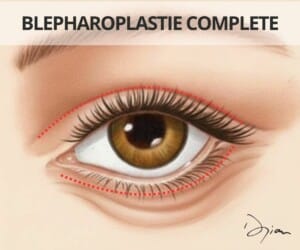
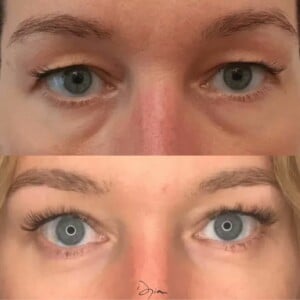
- Lower blepharoplasty acts primarily on puffiness and sagging of the lower eyelid. It smoothes the under-eye area and softens the tired look of relief.
- Upper blepharoplasty corrects the excess skin that falls onto the eye, the heavy eyelid, which sometimes impairs vision.
- The 4-eyelid blepharoplasty opens up the whole eye, treating both the upper and lower parts, while respecting the face's natural expression.
WHO IS THE RIGHT CANDIDATE FOR A LOWER EYELID AESTHETIC PROCEDURE: YOUNG PATIENT, TIRED PERSON, LOOSE SKIN?
The right candidate presents genuine bags under the eyes or a long-lasting excess of skin, as determined in a consultation. They may be young with a genetic component, or older with marked skin aging. What counts is the existence of a stable deformity, good general health and a clear motivation for blepharoplasty, with realistic expectations of the result.
WHAT TYPE OF ANESTHESIA IS USED FOR LOWER BLEPHAROPLASTY: LOCAL, LOCAL WITH SEDATION OR GENERAL?
For isolated lower blepharoplasty, local anesthesia with sedation is often sufficient and very comfortable. In most cases, the patient wakes up quickly and can return home the same day. When several procedures are combined, such as an upper blepharoplasty, general anesthesia is often preferred for comfort and safety. The final choice is made in consultation with the anaesthetist, taking into account your medical history, your concerns and the expected duration of the procedure.
WHEN CAN I RETURN TO WORK AFTER LOWER BLEPHAROPLASTY?
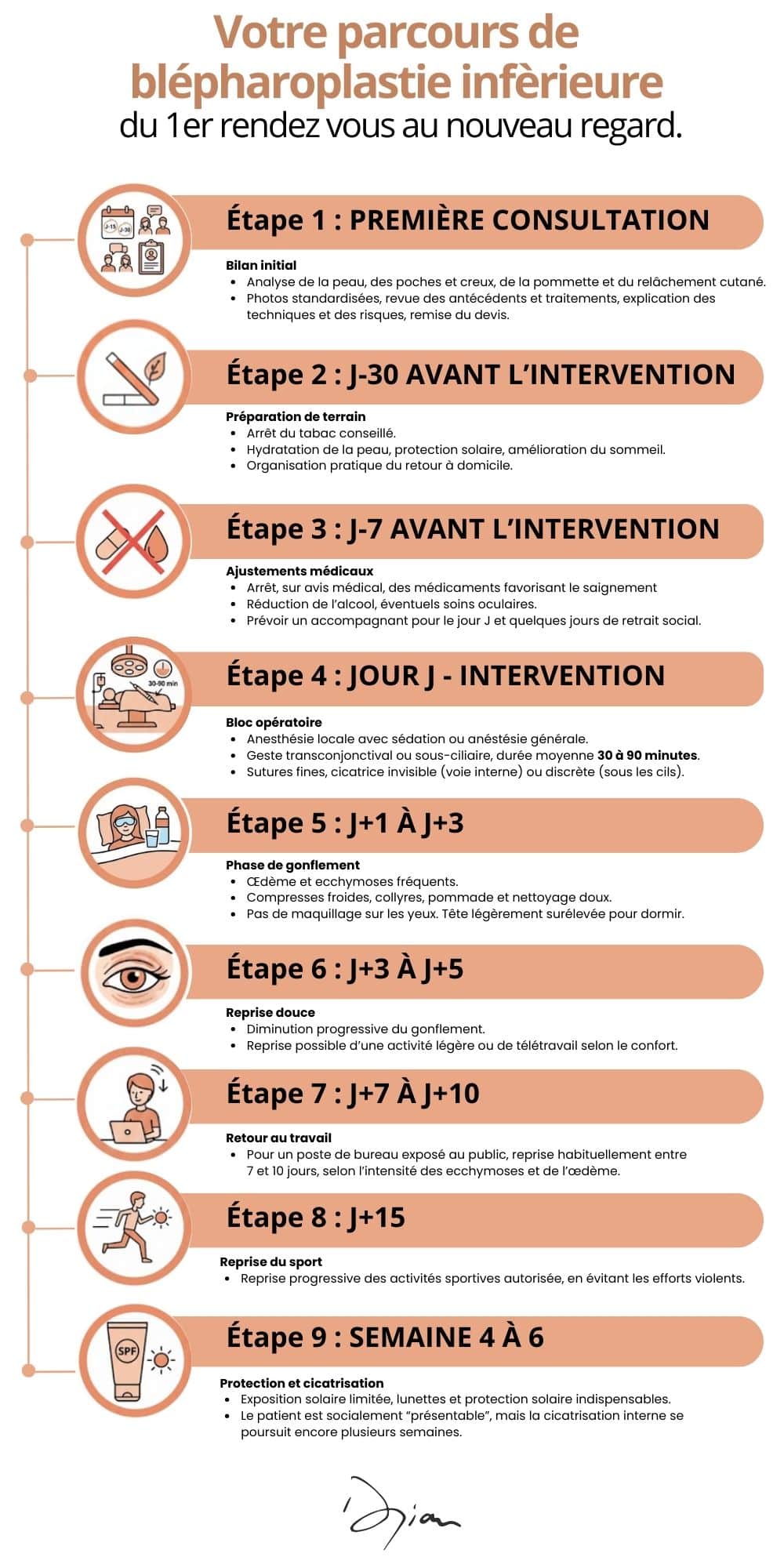
Resuming work depends above all on your social exposure and the type of activity. For office work with little exposure, some patients return to work between D+5 and D+7. For a job in constant contact with customers, ten days is often more comfortable, just long enough for the bruising and swelling to diminish. However, internal healing continues beyond that, over several weeks.
IS LOWER BLEPHAROPLASTY PAINFUL FOR THE FIRST FEW DAYS OR JUST UNCOMFORTABLE?
In the vast majority of cases, lower blepharoplasty is described as little pain. Patients mainly report discomfort, tension or a pulling sensation in the eyelids, sometimes of tingling.
Simple analgesics are generally sufficient to control these symptoms. Swelling and bruising can be visually distracting, but do not represent intense pain. This period of’discomfort gradually decreases over 1 to 2 weeks, This is in line with swelling absorption.
WHY DO SOME PEOPLE NOTICE A RETURN OF PUFFINESS EVEN THOUGH THE FAT HAS BEEN REMOVED?
What is often perceived as a« pocket return »In reality, "sagging" is the evolution of aging. The fat removed during blepharoplasty does not regrow, but the skin continues to sag, the cheekbone may droop and new hollows appear. Together, these can give the impression of puffiness. In some cases, minor medical touch-ups or surface treatments are all that's needed to reharmonize the area without further major surgery.
CAN LOWER BLEPHAROPLASTY BE COMBINED WITH A FACELIFT TO IMPROVE HARMONY?
Yes, the combination of lower blepharoplasty and facelift is common when aging affects both the eyes and the oval of the face. Treating only the eyelids in a context of overall sagging can create a mismatch. The cervico-facial lift corrects ptosis of the tissues of the lower and middle face, while blepharoplasty treats bags and sagging eyelids. This combined approach ensures a more even improvement, provided it is well planned in consultation and adapted to your morphology, age and expectations.
IN THESE SECTIONS
TO DR. DJIAN