


Surgical Procedure: Carcinomas and Melanomas
Malignant skin tumors require surgical removal. Basal cell carcinomas are a type of skin cancer, often caused by sun exposure. They are therefore more common on sun-exposed areas such as the face and limbs.
- Skin cancers include carcinomas (basal cell, squamous cell) and melanoma, All of them require rapid treatment.
- The basal cell carcinoma is the most common, locally slow-growing, sun-related skin cancer.
- The squamous cell carcinoma and above all the melanoma are more aggressive, with the risk of metastasis and recurrence.
- Main risk factors : sun exposure, light phototype, history of skin cancer, family background and immune deficiency.
- Diagnosis is based on dermatological examination, sometimes a biopsy and extension workup (ultrasound, CT scan).
- The reference treatment is’surgical removal with safety margins, histological analysis and dermatological follow-up, sometimes supplemented by curage or systemic treatments.
CARCINOMAS & MELANOMAS - DEFINITION
There are different types of skin cancer: carcinomas and melanomas.
Carcinomas
There are 2 types of carcinomas: superficial basal cell carcinoma and squamous cell carcinoma (nodular basal cell carcinomas).
The first are the most common. They are slow-growing tumors, primarily local, and never metastasize.
The latter are much more aggressive and can metastasize.
Melanoma
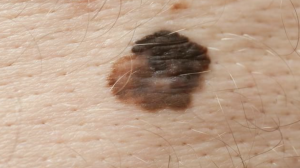
A melanoma is a tumor that develops from melanocytes, the cells responsible for skin pigmentation.
Melanoma accounts for 10% of skin cancers. It can occur at any age but is more commonly seen in individuals who experienced sunburns before the age of 8.
Melanoma is the most serious form of skin cancer. It must be removed as quickly as possible.
In general, skin exposed to the sun is most susceptible to skin cancers.
RISK FACTORS FOR SKIN CANCER
Skin cancers are common.
Several risk factors can be identified:
- Hereditary ;
- Sun exposure: chronic (carcinoma) or repeated (melanoma) ;
- Fair skin type: light skin, light eyes, light hair;
- Personal history of skin cancer;
- Immune deficiency.
SKIN CANCERS
Basal Cell Carcinoma
Basal cell carcinoma is a relatively common malignant skin tumor.
Like all skin tumors, it is promoted by sun exposure. Its growth is slow and it primarily affects patients over the age of 50. It is possible to have multiple skin carcinomas.
This cancer is very treatable, as soon as it is diagnosed.
Its most common form is the «pearly pearl».
Squamous cell carcinoma
Squamous cell carcinoma develops at the expense of the skin's squamous cells (keratinocytes).
To confirm the diagnosis before removal, a biopsy may be performed to examine the cancerous cells.
Additional examinations to assess locoregional extension are possible. These may include ultrasound or CT scans.
Melanoma
A melanoma is a tumor that develops from melanocytes.
Melanocytes are the cells that give the skin its pigmentation. They produce melanin.
Frequent and repeated sun exposure since childhood is the main risk factor. Repeated sunburns are also significant risk factors.
Diagnosing melanoma
The ABCDE rule helps in the diagnosis of melanoma:
- A for asymmetry ;
- B for Irregular edges ;
- C for a heterogeneous or very dark color ;
- D for a Diameter (size) ;
- E for Evolution rapide.
Melanoma treatment
It is essential to perform a melanoma surgery promptly to remove it as quickly as possible. The faster a malignant melanoma is removed, the lower the chances of the cancer spreading. Similarly, the risk of recurrence is reduced.
Your surgeon can remove the tumor through excision (removal using a scalpel) or via photodynamic therapy.
An exeresis-biopsy will be performed to determine the type of lesion and deep invasion.
A more general work-up may be prescribed to assess the possibility of locoregional (lymph node) or distant invasion.
Complementary treatments
In addition to surgical removal of the melanoma, complementary treatments are available:
- Lymph node dissection ;
- chemotherapy or immunotherapy.
SURGICAL TREATMENT
Surgical excision is the most commonly recommended treatment. An esthetic surgeon or a dermatologist can perform this surgery.
First, the lesion is visually identified and biopsied for histological diagnosis.
The histological type can be used to specify the surgical procedure, and in particular the margins of exeresis.
In fact, the safety perimeter (margin) can range from 2 mm to 2 cm, depending on the tumour.
Excisional surgery is usually performed under local anaesthetic.
Once the tumor has been removed, it is sent for histological analysis.
The results of this analysis are generally reported in 10 to 15 days. Depending on the result, a dermatological follow-up is organized.
Your Questions
Frequently Asked Questions in Consultation
WHAT ARE THE REPAIR OPTIONS AFTER REMOVAL?


Excision of skin tumors most often leaves a defect in place of the lesion.
Depending on the type of lesion and its location, several repair techniques are possible.
- Direct closure;
- Secondary intention healing;
- Split-thickness or full-thickness skin graft;
- Local flap.
For example:
– A basal cell carcinoma on the back or arm can be removed immediately with margins and closed by direct suture.
– A basal cell carcinoma on the nose will be removed and sent to the lab for histological analysis. Only if the results allow will reconstruction be considered.
IS RECURRENCE POSSIBLE?
Yes.
Recurrence at the site of the scar is possible.
Another lesion of the same type may also occur.
For these reasons, regular dermatological follow-up is essential.
WHAT COVERAGE DOES SOCIAL SECURITY PROVIDE?
Most of the time, the removal of a basal cell carcinoma is purely for cosmetic purposes and is therefore never covered by Social Security.
Removal of a squamous cell carcinoma or melanoma is partially covered when the cancer has metastasized.
Social Security reimburses the removal of a problematic mole at 70%, based on a reimbursement rate of €30.05. Any additional costs may be covered by your supplementary health insurance.
Dr Jérémy Djian is a plastic surgeon based at 5 square Thiers, near the Victor Hugo roundabout, in the 16th arrondissement of Paris.
He trained in Paris and worked on the team of Professor Laurent Lantieri, a leading authority on face transplant surgery.
YOU MAY BE INTERESTED
IN THESE SECTIONS

TO DR. DJIAN