
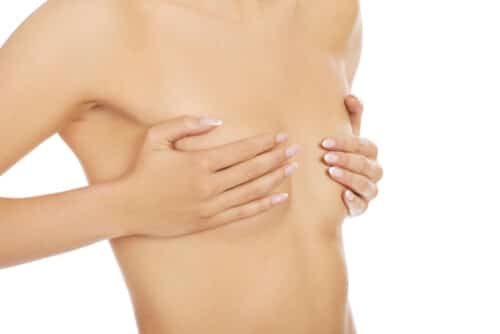
fb Different breast shapes: which cosmetic surgery?
Dr Jérémy Djian, 5 Square Thiers , 75016
menu close
Appointment appointment

Tips & advice

Different breast shapes: identification guide and solutions

published on 07.12.2025 by Dr Djian
<noscript><img width=
Summary
  • UNDERSTANDING THE BREAST: ANATOMICAL STRUCTURE AND SHAPE FACTORS
  • MAJOR BREAST MORPHOLOGIES: COMPLETE TYPOLOGY
  • DIFFERENT NIPPLE SHAPES: AESTHETIC IMPACT AND BREASTFEEDING
  • HOW TO IDENTIFY YOUR BREAST SHAPE?
  • CHANGES IN BREAST SHAPE: AGE, PREGNANCY, WEIGHT, HORMONES
  • WHEN THE SHAPE BECOMES PATHOLOGICAL: PTOSIS, ASYMMETRY, TUBEROSITY, AGENESIS
  • AESTHETIC AND SURGICAL SOLUTIONS FOR DIFFERENT BREAST SHAPES
  • CONCLUSION: ACCEPT YOUR MORPHOLOGY OR CORRECT A REAL DISCOMFORT
In short
  • All breasts have different shapes, sizes and volumes: this is not a defect but a normal anatomical variation.
  • Understand breast structure: gland, fatty tissue, skin, ligaments, submammary fold, areola and nipple.
  • Genetics, hormones, pregnancy, breastfeeding and weight variations all influence breast shape and the risk of ptosis.
  • 8 types of breasts: round, pear-shaped, east-west, asymmetrical, tuberous, drooping, flat, with their characteristics.
  • When lingerie is all that's needed and when measured breast surgery can correct volume, shape or embarrassing asymmetry.

Not all breasts are the same size, and their shape varies. Round, pear-shaped, asymmetrical, tuberous, with low breast volume or drooping due to ptosis caused by time, pregnancy or weight: the difference exists and is an anatomical definition, not a defect.
We analyze breast morphology, skin, glandular/adipose distribution, the role of hormones, the pectoral muscle, the submammary fold, the areola and the nipple.
You'll know choosing the right bra, to understand when a breast surgery (mastopexy, breast augmentation, lipofilling, prosthesis) becomes relevant and when simple maintenance is sufficient.
Let's move on to the anatomical structure.


UNDERSTANDING THE BREAST: ANATOMICAL STRUCTURE AND SHAPE FACTORS


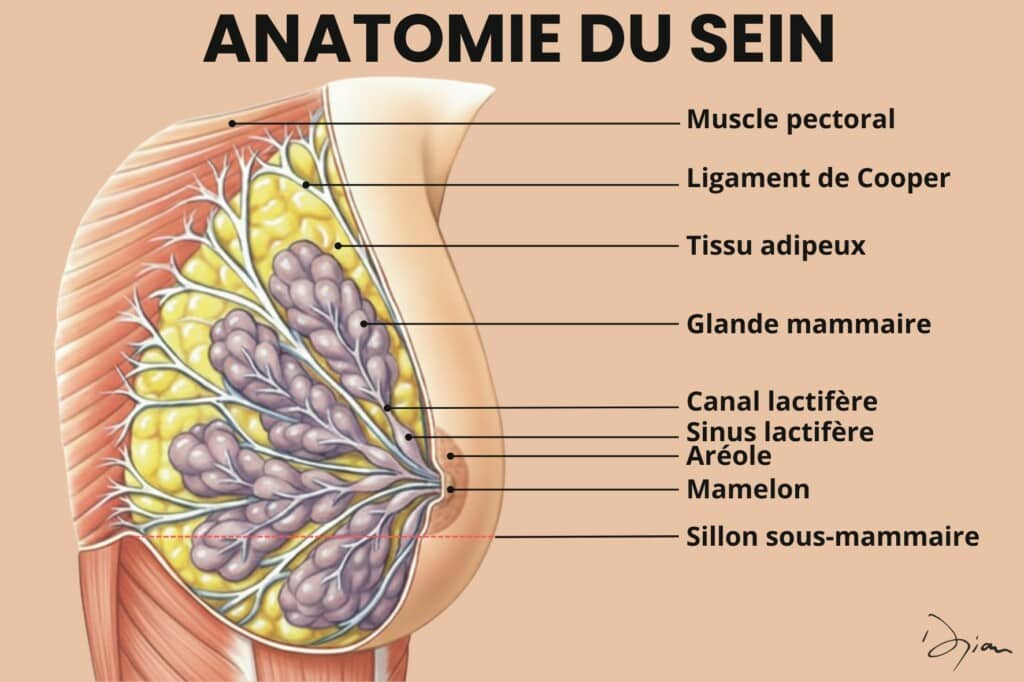
breast anatomy


The breast is an exocrine gland (gland with external secretion), resting on the pectoralis major muscle but anatomically independent. It combines the mammary gland (for milk production), fatty tissue, skin and Cooper's ligaments, the internal “shrouds” that connect the gland to the skin and provide support.

In advancet, the areola-nipple “complex” brings together the small ducts that carry milk, as well as the nerves and vessels: this is the true sensitive and aesthetic center of the breast.
Backwards, The breast can slide slightly over the ribcage thanks to a thin layer of flexible tissue, enabling the surgeon to place a prosthesis or reshape the breast without touching the muscle.

The breast base and the submammary fold (fold under the breast) largely determine breast shape and type.

Skin quality (thick and tonic or thin and fragile) determines resistance to ptosis.

If you have any doubts about the development or shape of your breasts, an examination by Dr. Djian in Paris will provide you with a precise anatomical analysis.


WHY DO BREASTS HAVE DIFFERENT SHAPES?


Breast shape is the result of a balance between several factors:

  • genetics,
  • hormones,
  • weight,
  • thorax architecture
  • and fabric quality.

Genetics largely defines the breast base, the width of the thorax, the proportion of glandular tissue to fatty tissue, and the thickness of the skin.

Hormones (estrogen, pregnancy, breastfeeding, menopause) modify the density of the mammary gland and the distribution of adipose tissue. During pregnancy, the milk ducts expand, milk production increases mammary volume; after weaning, the gland regresses, sometimes faster than the skin retracts, resulting in a reduction in the volume of milk. promotes breast ptosis.

From a surgical point of view, a distinction is made between.., skin ptosis (skin too distended, but gland still projected) and glandular ptosis (the gland itself descends below the submammary fold). Pear-shaped breasts, with a lot of volume in the lower part, are more prone to ptosis than more compact “apple” breasts.

Finally, when Cooper's ligaments are thin or stretched, If the skin is very thin or the volume of the breasts large, the breasts are more subject to the laws of gravity.


MAJOR BREAST MORPHOLOGIES: COMPLETE TYPOLOGY


8 RECOGNIZED BREAST TYPES


ROUND BREASTS


round breasts

Round breasts are evenly distributed between the upper and lower parts. Round breasts give a naturally full décolleté, even without a push-up. The base can be small or wide, and the volume of the breasts modest or generous. A bra providing comfort and support is often sufficient. This type of breast is not a universal ideal, but one shape among others, just as normal as a pear or drop-shaped bust.

Surgically, this morphology is favorable to moderate breast augmentation: the skin envelops the implant well, and the breast shape remains stable over time, especially if the skin is thick and toned.


PEAR-SHAPED BREASTS


pear-shaped breasts

Pear-shaped breasts concentrate more volume in the lower part, with a softer upper pole. Very common, this breast shape adapts to a wide range of cup sizes. In profile, the drop-shaped breast is very harmonious, but this type of breast is a little more susceptible to breast ptosis, as the glandular-fatty mass “weighs” downwards. The distance between the areola and the submammary fold is an important benchmark: when it exceeds 6 cm, ptosis is often considered to have begun.


SAGGING BREASTS (PTOSIS)


sagging breasts

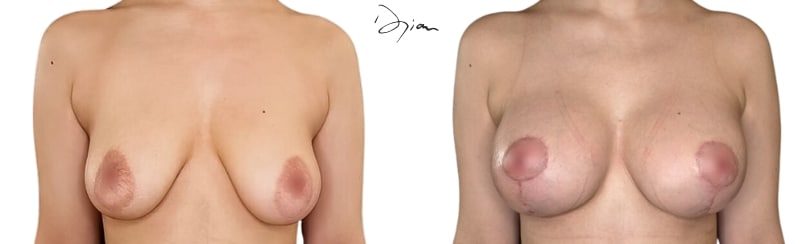
We speak of sagging breasts when the nipple approaches or passes beneath the submammary fold. Ptosis is classified into several degrees, depending on the position of the nipple and gland. It results from distension of the skin sheath, loss of tension in Cooper's ligaments, and sometimes a reduction in breast volume after pregnancy, breast-feeding or weight loss. Breast ptosis is not a disease: it is a logical mechanical evolution. Surgical correction is considered especially when it interferes with dressing, sports activities or self-esteem.


EAST-WEST« BREASTS AND SPREAD BREASTS


In “east-west” breasts, the nipples point more outwards, with a wider central space. In spread breasts, the mammary base is implanted more laterally on the thorax. The volume may be round or pear-shaped, but hardly centered in the middle. This does not indicate any abnormality in the breast tissue, only a type of breast. Brassieres with narrow gaps, interlocking cups and lateral support can improve cleavage.


ASYMMETRICAL BREASTS


Asymmetrical breasts

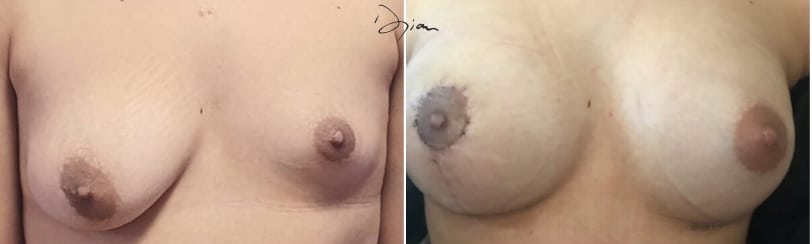
Slight breast asymmetry is extremely common: a slightly larger breast, a slightly higher areola... Breast asymmetry is considered significant when there is at least a one-cup difference or an obvious difference in breast shape. In this case, lingerie can already help to balance things out visually, but targeted surgical correction can be envisaged to harmonize breast size, shape and areola level. Depending on the case, correction may involve a small reduction on one side, a volume increase on the other, or targeted lipofilling.


TUBEROUS BREAST


Tuberous breasts have a narrow base, an underdeveloped lower part and a concentrated volume behind the areola. The whole may resemble a bell or a tube. The areola often appears wide or bulging. This is a breast development disorder, not a simple sagging. This breast shape can cause significant discomfort. Correction is based on specific breast surgery combining remodelling of the gland, opening of the base and, sometimes, volume augmentation by prosthesis or own fat.


FLAT BREASTS OR AGENESIA


flat breasts


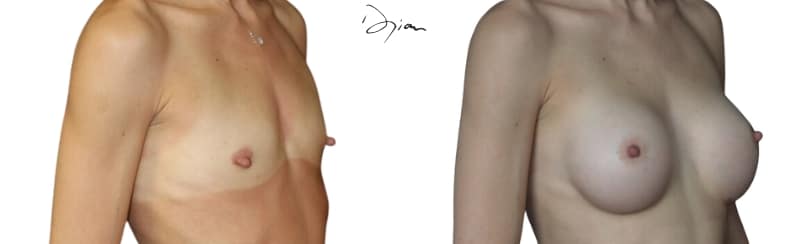
Mammary agenesis corresponds to a total or almost total absence of gland development and breast volume. The chest remains flat, with no real projection and very limited relief. This is not a variation but a lack of formation. The minimalist or wire-free bras are often the most suitable. Augmentation may be considered when the volume deficit has a marked functional or aesthetic impact.

To find out whether your breast type is simply a variation in shape or a genuine anomaly, a specialized examination may be useful. In case of doubt or daily discomfort, a consultation at Docteur Djian's practice in Paris allows you to take stock of your situation without the need for surgery.


DIFFERENT NIPPLE SHAPES: AESTHETIC IMPACT AND BREASTFEEDING


Areola diameter (usually 3.5 to 5 cm) and nipple projection vary enormously from one woman to another. Sensitivity is uneven. The upper part of the breast is often the most sensitive, the areola a little less so, and the nipple sometimes surprisingly insensitive. There's nothing abnormal about these characteristics; they simply need to be known before any surgery.


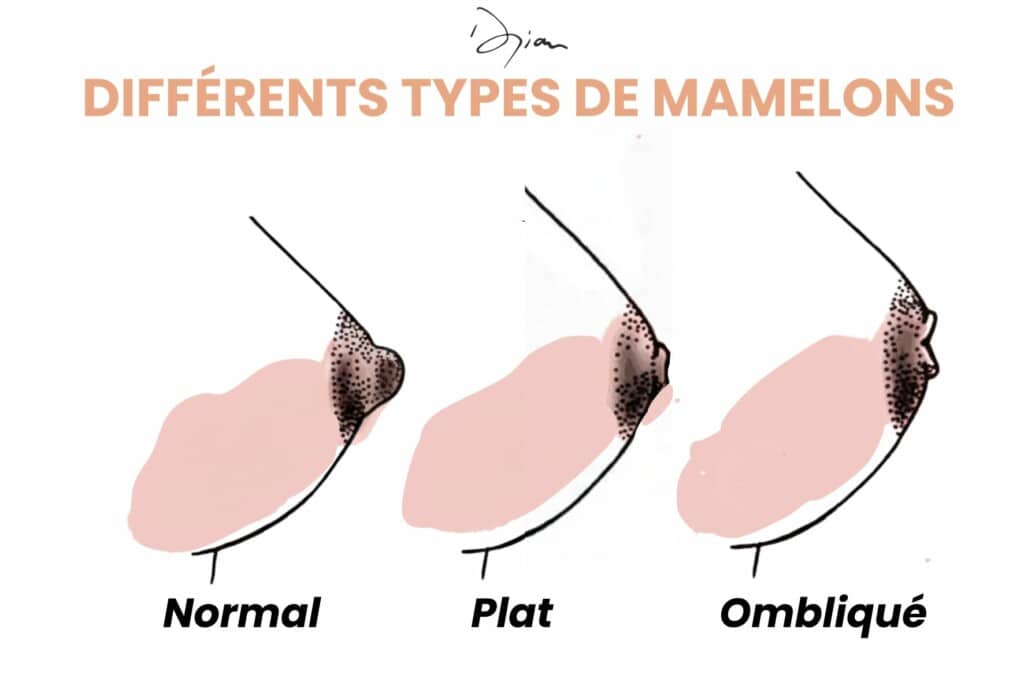
Types of nipples

FLAT MAMELONS


Flat nipples protrude only slightly from the areola, even when cold or stimulated. The shape of the breast may appear smoother, with no effect on breast volume or milk production. Breastfeeding remains possible if the milk ducts are functioning. This feature is primarily aesthetic. Some women accept it readily, while others prefer a discreet correction when the impact on self-image becomes important.


UMBILICATED NIPPLES


Umbilical (or invaginated) nipples are turned inwards, partially or totally. When this form has existed since adolescence and remains stable, it is usually a simple variant. On the other hand, a nipple that suddenly becomes inverted, accompanied by pain, skin retraction or discharge, should be investigated to rule out an underlying pathology, such as breast cancer.

In terms of aesthetics, targeted surgical correction can be proposed, while preserving breastfeeding function if possible.


PROTRUDING, ASYMMETRICAL NIPPLES


Protruding nipples are very visible under clothing. They do not change the shape of the breast, but can be experienced as too present. Moulded or lightly padded cups reduce this effect.

Asymmetrical nipples differ in size or orientation and can accentuate overall breast asymmetry. When this becomes a source of complication, correction of areola shape or diameter can be combined with breast shape surgery.


HOW TO IDENTIFY YOUR BREAST SHAPE?


IDENTIFY YOUR BREAST SHAPE AT HOME


Stand in front of a mirror, topless, in a natural position. Start by observing the base: are your breasts close together or is there a large central space?

Then look at the top: full, slightly hollow or rather flat?

Next, locate the level of the nipple in relation to the inframammary fold: above, at the same level, or below?

Finally, observe the orientation of the nipples: forward, slightly downward, or outward? This description will help you recognize whether you have round, pear-shaped, spread breasts or breast ptosis.

A second useful test involves measuring the approximate distance between clavicle and nipple, then between the areola and the submammary fold. As these distances increase, so does the probability of ptosis.

But be careful: these measurements are guidelines, not judgments. They simply help to objectify how you feel in front of the mirror.


WHEN TO CONSULT: WARNING SIGNS OR SEVERE ASYMMETRY


You should consult your doctor if you notice recent deformity, sudden breast asymmetry, A nipple that suddenly inverts, abnormal discharge, a hard area or persistent pain.

Similarly, very pronounced breast ptosis or tuberous breasts may warrant treatment if the discomfort is significant.

Finally, if breast shape is weighing on your self-confidence, talking to a specialist is a good first step towards easing your worries.

Doctor Djian in Paris regularly sees patients to distinguish between what is normal, what is a malformation and what can be corrected.


CHANGES IN BREAST SHAPE: AGE, PREGNANCY, WEIGHT, HORMONES


Over time, the mammary gland changes: development at puberty, variations during the menstrual cycle, hypertrophy during pregnancy, then progressive involution with age. Pregnancy and breast-feeding distend Cooper's skin and ligaments; after weaning, the gland diminishes in volume, sometimes leaving a relative “void” in the upper part, typical of breasts that “sag” after maternity.

Weight changes mainly affect adipose tissue. With repeated weight loss and gain, the skin stretches, the dermis thins and support structures loosen, leading to breast ptosis. At menopause, the gland becomes fatter, the proportion of active breast tissue decreases, and the breasts become softer, sometimes heavier. Understanding these mechanisms makes you feel less guilty: most of the changes you observe are the normal expression of your body's hormonal and mechanical life.

We are considering a breast reduction, A mastopexy or volume enlargement can only be performed if the shape of the breasts causes real discomfort, such as pain, difficulties with posture, clothing limitations or lasting loss of self-esteem.


WHEN THE SHAPE BECOMES PATHOLOGICAL: PTOSIS, ASYMMETRY, TUBEROSITY, AGENESIS


There's a fine line between anatomical variation and true pathology. Significant breast ptosis, major breast asymmetry, tuberous breasts or breast agenesis deviate sufficiently from the “average” to cause significant functional or psychological discomfort.

In these cases, surgery is not just a cosmetic gesture: it can improve posture, comfort, access to suitable lingerie and, above all, self-esteem.


AESTHETIC AND SURGICAL SOLUTIONS FOR DIFFERENT BREAST SHAPES


WHEN TO CONSIDER COSMETIC SURGERY?


Breast surgery is considered when the shape or size of your breasts causes significant discomfort: marked breast ptosis, tuberous breasts, severe breast asymmetry, agenesis, very heavy breasts causing pain.

The aim is not to achieve “ideal” breasts, but to obtain a breast volume, shape and size that suit you and your figure.

A detailed interview with an experienced surgeon, such as the Doctor Djian in Paris, helps to clarify your expectations and what is really achievable.


MAIN TECHNIQUES


MASTOPEXY: LIFTING A SAGGING BREAST


Mastopexy (or breast lift) aims to lift a sagging breast without necessarily changing its volume. The surgeon removes excess skin, resculpts the gland and replaces the areola higher up, at the top of the curve. The breast is thus “repositioned” on the thorax, with a more youthful shape and better support. Depending on the degree of breast ptosis, scars may be placed around the areola, in a vertical or inverted-T shape. The aim is not to create a fixed breast, but a natural breast that falls harmoniously over time.


BREAST AUGMENTATION: RESTORING VOLUME


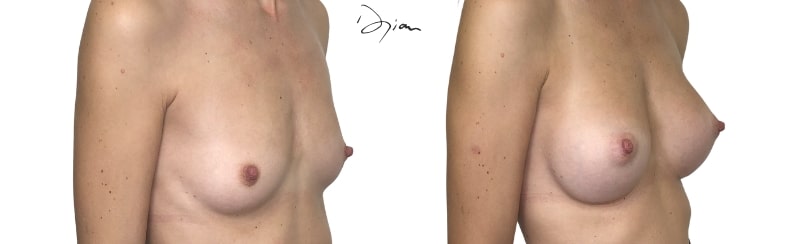
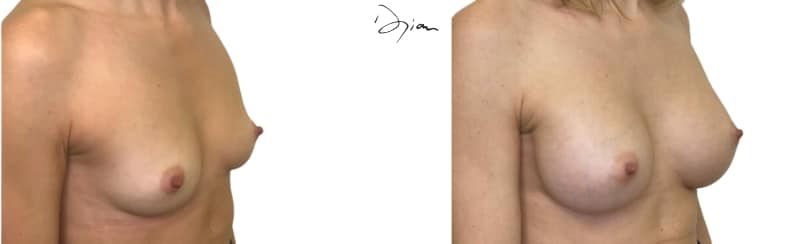
Breast augmentation is used to increase breast volume, or to fill out breasts deemed “too flat” or emptied after pregnancy or weight loss. It can be performed by silicone gel prosthesis, placed in front of or behind the pectoral muscle, or by lipofilling, by reinjecting your own fat after liposuction.

Implants offer greater, predictable volume gain; fat offers a very natural, but more moderate result. The choice depends on your morphology, skin quality and desired result.

To learn more about how to enlarge your breasts, you can refer to the following article: How to enlarge your breasts: implants, lipofilling, other methods?


BREAST REDUCTION: LIGHTENING HEAVY BREASTS


Breast reduction reduces breast size when breast volume is responsible for back pain, dressing difficulties, sporting discomfort or an aesthetic complex. The surgeon removes part of the gland and fat, It lifts the areola and tightens the skin envelope to create a smaller, lighter breast that's better proportioned to the rest of the body.

Beyond appearance, many patients describe how comfortable they feel in their daily lives after this type of surgery.


COMBINING GESTURES: CORRECTING VOLUME, SHAPE AND ASYMMETRY


In reality, needs often lie on the borderline between several situations: sagging and empty breasts, heavy but asymmetrical breasts, tuberous breasts with low volume... This is why techniques can be combined: mastopexy associated with a small prosthesis, reduction of one breast and augmentation of the other, targeted lipofilling to correct a hollow or a difference in shape.

The approach is tailor-made: it takes into account your morphology, the quality of your skin and your expectations. During the consultation, the surgeon clearly explains what is reasonable, the scars to be expected and the type of result you can expect.


CONCLUSION: ACCEPT YOUR MORPHOLOGY OR CORRECT A REAL DISCOMFORT


There is no single normal breast shape, but a wide variety of breast types: round breasts, pear-shaped breasts, asymmetrical breasts, tuberous breasts, athletic breasts... The key is to distinguish what is the natural diversity of the female breast from what is a real pain or handicap in everyday life.

Appropriate lingerie, effective support, posture and weight stability play a powerful role. If, despite all this, breast shape remains a source of complex, a specialized consultation can help you regain control of your relationship with your breasts.

Doctor Djian in Paris will work with you to understand your morphology and, if you wish, consider a measured, personalized correction.

Your Questions

FREQUENTLY ASKED QUESTIONS ABOUT BREAST SHAPE

Does the shape of the breasts influence the result of a breast augmentation?

more less

Yes, a bell-shaped chest The implant does not create the same effect as a flat breast. rounded appearance and can look less full in top. The cup size therefore depends on the BREAST TYPE and prosthesis shape and size.

Do hormones play a role in the shape and texture of breast tissue?

more less

The hormones, especially estrogens, modify the development from breast tissue, its density and curves. They can influence the breast size, The result is an improvement in the quality of the skin, its suppleness and its evolution during puberty, pregnancy or after menopause. The result is unique for every woman.

What is the shape of a perfect bust?

more less

The “ideal bust” is not an artistic myth, but a set of technical guidelines.

Classic criteria for cosmetic surgery :

  • fuller lower pole, discreet upper pole
  • clean, well-positioned submammary fold
  • areola centered, never downward-facing
  • harmonious décolleté, without excess or fusion
  • gradual curve between clavicle and breast, with no break
  • proportion with bust, shoulders, waist
  • symmetry acceptable, not mathematical

So it's not size or roundness that makes the ideal, but the balance between volume, position and silhouette.

Why do breasts grow larger with age?

more less

Over time, weight gain, sagging skin and lower hormone levels modify the volume. The gland regresses and fat increases, changing the shape and distribution of breast tissue. This is not an “anomaly”, just the mechanical effect of aging.

Are my asymmetrical breasts normal?

more less

Yes, in the vast majority of cases. Slight breast asymmetry, with one breast slightly larger or higher than the other, is part of normal variations in breast shape. The main cause for concern is if the difference appears rapidly, becomes very marked or is accompanied by pain, redness or a change in texture.

How can I tell if my breasts are really sagging?

more less

Stand in front of a mirror and spot your groove at-mammary. If the nipple is above the fold, there is no significant breast ptosis. If the nipple is above it, there is no significant breast ptosis. slight. Significantly below this level, especially if the nipples point downwards, ptosis will occur. is more important.

It's not dangerous in itself, but when this breast shape interferes with lingerie choices, sporting activities or self-image, a breast surgery consultation may be useful to discuss options.

Can hormonal changes affect breast shape?

more less

Exactly. The menstrual cycle, pregnancy, breastfeeding and menopause regularly modify skin tension, glandular density and the proportion of adipose tissue. Hence the sensation of more swollen breasts at certain times, or more supple breasts with age. These variations in breast shape are usually reversible or progressive.

Consult us if a breast suddenly changes volume, shape or texture, or if pain persists.

What did you think of this article?

Rate it !

Average Rating 4.5 / 5. Number of Votes 4

No votes yet, be the first to rate this article.

Dr. Jérémy Djian
Dr. Jérémy Djian

Dr Jérémy Djian is a plastic surgeon based at 5 square Thiers, near the Victor Hugo roundabout, in the 16th arrondissement of Paris.

He trained in Paris and remains attached to the hospital in the prestigious department of Pr Laurent Lantieri.


Going further
THESE ITEMS CAN
IN THESE SECTIONS
Your Questions
ASK YOUR QUESTIONS
TO DR. DJIAN