
fb How to lift sagging breasts?
Dr Jérémy Djian, 5 Square Thiers , 75016
menu close
Appointment appointment

Surgery

Lift sagging breasts: causes, surgical solutions (lift, prostheses, reduction) and results

published on 22.12.2025 by Dr Djian
<noscript><img width=
Summary
  • UNDERSTAND SAGGING BREASTS (BREAST PTOSIS) BEFORE CHOOSING A SOLUTION
  • WHICH SURGERY TO USE TO LIFT SAGGING BREASTS? DECISION GUIDE
  • BREAST LIFT: TECHNIQUES, SCARS AND CHOICE OF METHOD
  • PROCEDURE AND POST-OPERATIVE FOLLOW-UP (DAY D → FOLLOWING MONTHS)
  • RESULTS OF A BREAST LIFT: WHAT YOU CAN EXPECT AND ITS LIMITATIONS
  • RISKS AND COMPLICATIONS: SAFETY, SIDE EFFECTS, WHEN TO RECONSULT
  • PRICES, QUOTATIONS AND COVERAGE: WHAT IS PAID, BY WHOM, AND WHY
  • HOW TO CHOOSE A BREAST LIFT AESTHETIC SURGEON
  • ALTERNATIVES TO FACELIFTS: NATURAL, SPORT, CARE, AND REAL LIMITS
  • SPECIAL CASES: PREGNANCY, BREASTFEEDING, MOMMY MAKEOVER, WEIGHT VARIATIONS
  • CONCLUSION
In short
  • After pregnancy, weight changes or the passage of time, the breasts can sag and lose volume.
  • Lifting the breasts does not always mean fitting a prosthesis or increasing their size.
  • The breast lift corrects ptosis by acting on the skin, the gland and the position of the breast.
  • Post-operative care includes restraint, moderate pain and healing over several months.
  • The right choice depends on the diagnosis, not on a standard technique.

When a woman types “lift the breasts”It's not to read a cold definition of breast ptosis. It's because her breasts have changed: a sagging breast, a lower areola, a feeling of “emptiness” at the top, sometimes after pregnancy, sometimes with no obvious cause. Between a simple facelift (mastopexy), a facelift associated with a breast augmentation by implant or prosthesis, lipofilling or reduction if the volume is too great, there are several operations to lift a woman's breasts, and they don't all aim to achieve the same result.

The aim here is to to help you find your bearings, without any magic promises In short, clear answers before you make your choice: understand what “falls out” (skin, gland, nipple position), what the operation requires in the operating room (anesthesia, incision, dressing), what the usual after-effects are (convalescence over several weeks) and what to watch out for (scar, infection, complication, implant rupture). In short: clear answers, before choosing an implant. breast surgery.


UNDERSTAND SAGGING BREASTS (BREAST PTOSIS) BEFORE CHOOSING A SOLUTION


Before talking about facelifts, prostheses or breast reduction, it's important to understand what's really falling off.

Is it mainly the sagging skin, the mammary gland sliding downwards, the areola dropping below the sub-breast fold, or a combination of all these with a loss of breast volume?

The right solution doesn't depend on a technical word, but on a precise diagnosis of your situation.

The medical term is breast ptosis, But the important thing is to see whether your breasts are just a little slack or downright saggy, whether they're empty at the top, too heavy, or both. This is what skin-volume-areola position trio which allows you to choose between a simple breast lift, a lift with augmentation, lipofilling or breast reduction.


SAGGING BREASTS: PRACTICAL DEFINITION AND WARNING SIGNS


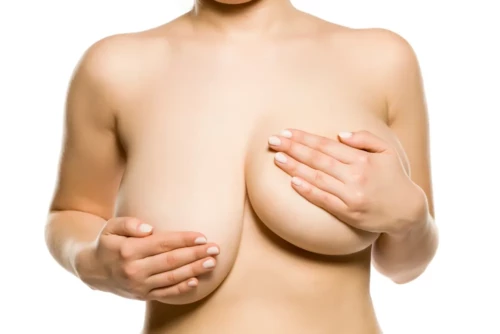
We talk about breast ptosis when the areola and nipple are at or below the submammary fold, with varying degrees of droop.

Other common signs include a hollow décolleté, breasts that «fill up» mainly at the bottom of the bra, and breasts that slide towards the armpit when lying down. You may have the impression that all the weight is carried by the bra, and that when you take it off, the breasts become completely deformed.

Breast ptosis can be mild, moderate or severe.

In mild forms of ptosis, The chest retains a certain curve, with the nipple slightly lower than its ideal position.

In marked forms, If the areola looks downwards, the breast tissue sags and excess skin becomes noticeable. These are the degrees that determine whether a simple ptosis correction or a more complete breast reconstruction is required.


COMMON CAUSES: PREGNANCY, BREASTFEEDING, WEIGHT, AGE, GENETICS


During pregnancy and breast-feeding, breast volume increases and then decreases, resulting in a loss of firmness. skin and supporting ligaments under tension. If the skin is fragile or the gland very large, the breasts fall more easily after childbirth.

Weight variations play a central role. With each weight gain and loss, breast tissue and fat change, while the skin envelope does not always retract. This is particularly noticeable after massive weight loss, such as after bariatric surgery. After a sleeve, the breasts can rapidly lose their volume and support, which explains why a breast lift after sleeve is frequently considered to correct marked sagging.

With age, skin quality changes, The fibers become looser, and the glandular tissue is transformed into fat, which is less «supportive». Some women, with the same pregnancies and the same weight, will keep almost the same breasts, while others will experience rapid sagging. The cause is not just what you've experienced, but how your skin and mammary gland react to it.


WHY DO SOME WOMEN HAVE SAGGING BREASTS AND OTHERS DON'T?


Two women of the same age, same number of pregnancies, same weight... and completely different breasts.

The difference is the quality of the skin, the thickness of the breast tissue, the basic shape of the breast and the natural position of the areola. Thick, toned skin is more resistant to variations in breast volume and gravity, whereas thin or sun-scarred skin gives way more quickly.

Tobacco, UV rays, hormonal variations and major weight fluctuations further weaken the skin's structure.

Conversely, a stable weight, good hydration, sun protection and good posture help to limit sagging, without preventing it altogether. The idea is not to make people feel guilty, I'm not here to explain why your breasts are drooping, while a friend's seem less marked for a similar life story.

If you need personalized advice on your type of sagging breasts, a consultation with the Doctor Djian in Paris provides a clear and reassuring visual diagnosis.


WHICH SURGERY TO USE TO LIFT SAGGING BREASTS? DECISION GUIDE


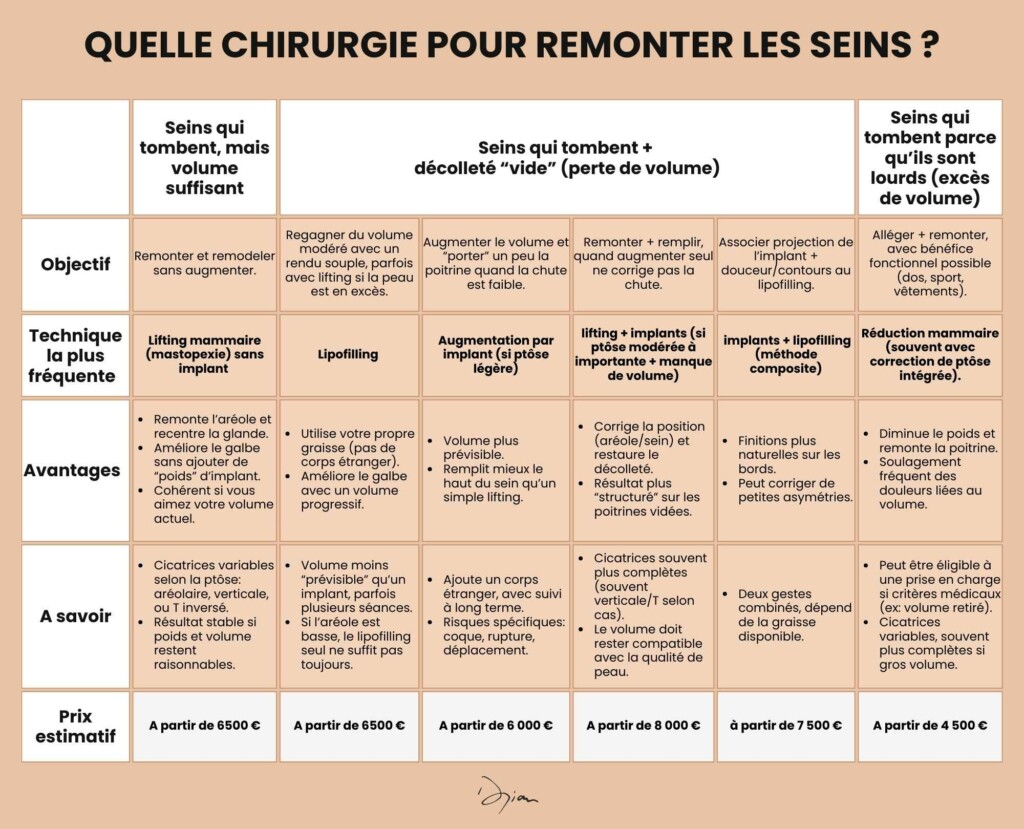
The logic is simple: we look at the degree of ptosis, breast volume and your final size request. Based on these three elements, we determine whether we should focus on tighten the skin, restore volume, lighten the mammary gland, or combine several procedures in the same breast surgery procedure.


Which surgery to lift the breasts


PTOSIS WITH SUFFICIENT VOLUME: BREAST LIFT (MASTOPEXY) WITHOUT IMPLANT


If your breasts sag but the volume suits you, breast lift without implant (mastopexy) is often the most logical solution. The aim is not to enlarge the breasts, but to lift and reshape them while preserving your own breast tissue. The surgeon removes excess skin, goes up the mammary glande and reposition the areola at the right height.

The scars may be only around the areola, associated with a vertical scar, or in the shape of a sea anchor (Inverted T) depending on the ptosis.

The desired result is a higher, shapelier breasts, with a harmonious décolleté, without adding the weight of a breast implant to an already fragile skin envelope.

This is pure breast ptosis surgery, aimed at restoring your breasts rather than transforming them.


PTOSIS WITH LOSS OF VOLUME: LIPOFILLING OR PROSTHESIS, WITH OR WITHOUT FACELIFT


When the breasts droop and look «drained», In many cases, there is a loss of breast volume in addition to sagging skin. In this case, lifting without filling can result in flatter, tighter breasts, but disappointing décolleté.

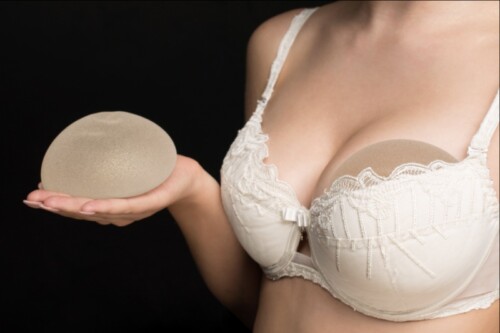
Two options are discussed: breast lipofilling (fat reinjection) or a breast implant, sometimes combined with a breast lift.

Lipofilling uses your own fat, removed by liposuction, then reinjected into the breast tissue to regain volume and improve contour.

The breast implant provides more predictable, larger volume, but adds a foreign body and extra weight. The choice depends on your skin quality, ptosis and desired volume.


PTOSIS WITH EXCESS VOLUME: BREAST REDUCTION TO LIFT AND LIGHTEN


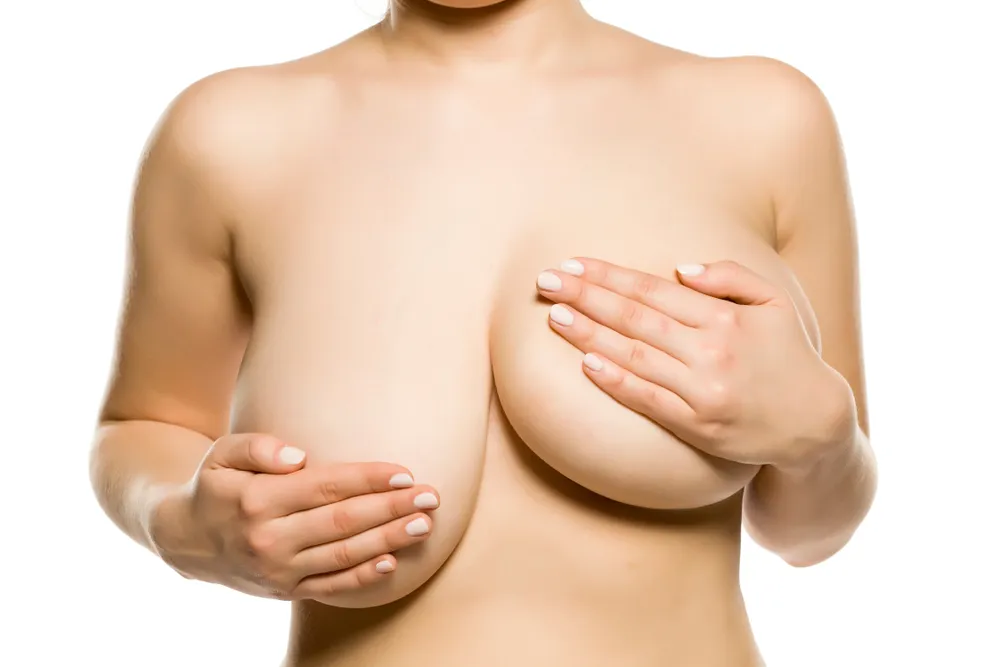
When the breasts fall off because they're too heavy, the logical solution is often a breast reduction.

The objective is to remove part of the breast tissue and skin, lift the breasts, reposition the areola and lighten the load on the back, neck and shoulders. The reduction corrects the ptosis and the weight that caused it.

Many women describe a physical relief after this type of surgery: less back pain, easier sports activities, better-fitting clothes. Depending on the volume removed and the context, social security coverage is only possible in the case of a breast reduction that meets precise criteria for volume removed, which is discussed in the preoperative consultation.


FACELIFT OR TENSOR THREADS: WHAT THEY CAN (REALLY) DO, AND WHAT THEY WON'T DO


Tensor threads or so-called «mini facelift without surgery» techniques are often presented as miracle solutions for lifting the breasts. In reality, their effect is limited to very slight sagging, on good-quality skin, with small breasts. They can improve very slight sagging, but cannot lift frankly sagging breasts.

They are not a substitute for a breast lift in cases of excess skin, low areola and sagging mammary gland. These methods may have a place in very select cases, provided they are presented for what they are: a little help, not real surgery to correct breast ptosis.


BREAST LIFT: TECHNIQUES, SCARS AND CHOICE OF METHOD


A breast lift is a cosmetic or reconstructive surgical procedure designed to lift sagging breasts by modifying the skin, the gland and the position of the areola.

There are several techniques for breast plastic surgery, with different scars. It's not you who chooses a «scar pattern»; it's the shape and degree of ptosis that dictate the safest method for achieving a lasting result.


BREAST LIFT TECHNIQUES: ROUND-BLOCK, VERTICAL, INVERTED T


The peri-areolar (round-block) facelift consists in tightening mainly around the areola, with a circular scar. It is suitable for slight breast ptosis, on small or medium-volume breasts. In practice, this technique is best suited to small lifts (often less than 2 cm).

The vertical technique adds a scar from the bottom of the areola to the submammary fold, further tightening the skin and reshaping the breast tissue.

For ptosis particularly on heavy breasts or after major weight changes, the inverted-T scar (or sea anchor) is the most frequently envisaged. It removes more excess skin and creates a firmer contour.


REPOSITIONING THE AREOLA AND NIPPLE: THE AESTHETIC OBJECTIVE


Repositioning the areola and nipple is one of the key gestures in this procedure.. The idea is to position the areola at a harmonious height in relation to the bust, centered on the shape of the breast.

The surgeon works on the skin and glandular tissue to maintain this new position over time.

Symmetry is the goal, but the result also depends on the starting point: if your breasts were very different, the operation reduces the asymmetry without always erasing it completely. Skin quality, healing and the evolution of volume in the months that follow also play a role in the final position.


BREAST LIFT WITH PROSTHESIS: WHEN TO COMBINE WITH AN IMPLANT


A breast lift can be combined with breast augmentation with prostheses when breasts are drooping and empty, with a very hollow décolleté. The breast implant makes it possible to restore volume at the top where a simple lift is not enough.

The choice of volume is not a whim, but a conscious balance between what you want and what your skin can handle without rapid relapse. Too heavy an implant, combined with poor skin tone, increases the risk of recurrence of ptosis.

Consultation is therefore essential to define a reasonable project, in line with your overall silhouette.


FACELIFT WITHOUT IMPLANTS: WHY SOME PATIENTS PREFER IT


Many women are looking for higher, firmer breasts without a prosthesis breast. They are looking for a result natural, in harmony with their bodies, no foreign bodies and no need to change implants later on.

When the initial breast volume is sufficient, an implant-free facelift can often achieve this more harmonious curve.

The breast is then remodeled with your own glandular tissue, recentering the volume and tightening the skin. The result is less «spectacular» than with a major augmentation, but more stable and closer to your anatomy.

This option is often preferred by women who want to correct sagging and recognize themselves in the mirror.


PROCEDURE AND POST-OPERATIVE FOLLOW-UP (DAY D → FOLLOWING MONTHS)


A breast lift to lift sagging breasts is still a surgical procedure that takes place on a regular basis. usually under general anaesthetic.

Understand the journey from initial consultation to operating room, recovery and outcome several month helps to reduce anxiety and prepare in a concrete way, rather than imagining the worst or fantasizing about a perfect tomorrow.


PREOPERATIVE CONSULTATION: HOW TO PREPARE FOR THE DECISION


During the initial consultation, the plastic surgeon will listen to your story pregnancy, breastfeeding, weight changes, your complexes and your waistline.

He examines your breast, takes medical photos, assesses breast ptosis, skin quality and breast volume. The various approaches are discussed together to define the best possible one, adapted to your morphology.

This is also the time to discuss scars, risks, convalescence, fees and possible conditions for coverage by Social Security or mutual insurance.

You will leave with written information and a detailed quotation. The decision is then taken calmly, and there is no urgency in scheduling the operation on the same day.


THE DAY OF THE OPERATION: ANESTHESIA, OPERATING ROOM, DURATION, DISCHARGE


On the big day, you arrive at the clinic on an empty stomach.

The team welcomes you, the anaesthetist checks the final details with you, the surgeon re-draws the markings on your chest.

The procedure takes place in the operating room, usually under general anesthesia, with discharge the same day or overnight, depending on the procedure and your medical situation.

Duration varies according to technique. As a rough guide, a breast lift often takes between 1 h 30 and 2 h 30, and a breast reduction around 1 h 30, depending on the extent of the procedure.

At the end, a bandage and a bra from are in place.

You leave after a few hours of surveillance, with precise instructions and a number to call in case of doubt.


CONVALESCENCE: PAIN, RESTRAINT, RETURN TO WORK/SPORT, SLEEP


The after-effects of a breast lift are generally marked by pain moderate, described as tension or a pulling sensation, especially in the first few days. In the case of implants, the pain is often more pronounced in the first 3 to 5 days, The «swollen» appearance of the breasts diminishes, especially during the first 15 days.

Simple analgesics are prescribed. Supporting-Contention bra is worn day and night for 1 month.

Resumption of sedentary work is generally possible after 7 to 10 days., depending on the extent of the intervention, more if your activity is physical.

High-impact sports and carrying heavy loads are generally delayed by 6 to 8 weeks, sometimes more, depending on the procedures performed, particularly after breast reduction.

It is advisable to sleep on your back to avoid crushing the healing chest.


SCARRING: WHY SCARS OCCUR AND HOW TO IMPROVE THEM


All breast surgery to correct ptosis involves incisions and scars.

They are first and foremost red, visible, sometimes a little thick, then lightening over the months. Their final appearance depends on the technique used, the tension on the skin, but also on your personal healing terrain.

Local care, stopping smoking, respecting support instructions and avoiding the sun are essential for a better result.

Specific treatments can be proposed to reduce scarring, in particular with Urgo Touch laser treatment. It is important to know that a scar evolves slowly and that it is necessary to wait. 12 to 18 months to see its final appearance.


RESULTS OF A BREAST LIFT: WHAT YOU CAN EXPECT AND ITS LIMITATIONS


A breast lift lifts the breasts, refocuses the areola, restores the shape of the breasts and improves the décolleté. But it doesn't transform your anatomy into a standard model. The result depends on the basic shape, the quality of the skin, the breast volume retained or increased, and the evolution of your BMI (body mass index) over time.


AESTHETIC RESULT: SHAPE, DÉCOLLETÉ, POSITION, SYMMETRY


After a successful breast lift, the breasts are higher on the chest, the submammary fold is better defined, the areola is refocused and the décolleté is fuller.

The overall silhouette becomes more harmonious, clothes fit better, and the bra supports a firmer, better-distributed shape. Many patients describe a clear improvement in self-confidence.

Symmetry is improved, but rarely perfect: no breast is perfect, even without surgery. Small differences in height, volume or scarring are normal. What's important is the overall result, seen from the front, from the side and with your clothes on.


DURABILITY: WHAT MAKES PEOPLE «STICK IT OUT» OR RELAPSE (WEIGHT, PREGNANCY, SKIN)


A breast lift doesn't freeze time. Your breasts will continue to change with gravity, age, weight variations and pregnancy. However, by removing excess skin and reshaping the mammary gland, you'll start from a higher, firmer base, which means you'll be able to enjoy a more youthful appearance. delays recurrence of ptosis.

Sustainability depends above all on the stability of your weight, It also depends on the quality of your skin, the size of your breasts after surgery and your lifestyle.

The greater the volume of the breasts, the more durable the result.. Pregnancy or major weight loss after ptosis correction can change the shape of your breasts again.


BEFORE/AFTER PHOTOS: HOW TO READ THEM WITHOUT BEING FOOLED


Before and after breast lift photos are useful, but must be interpreted carefully. Look at the angle of the shot, the light, the position of the arms, the presence or absence of a bra, and above all the time after the operation. A three-month result is not the same as a twelve-month result, especially when it comes to scars.

Compare cases that resemble your own morphology: same type of breast ptosis, starting volume, age, weight variations. Beware of images that are too smooth, retouched or taken in artificial poses. The most important thing is to have a direct discussion during the consultation, based on real, explained cases, rather than a photo gallery.

If you'd like to see concrete examples adapted to your situation, Dr. Djian in Paris will be able to show you comparable cases in consultation., in a confidential setting.


RISKS AND COMPLICATIONS: SAFETY, SIDE EFFECTS, WHEN TO RECONSULT


RISKS COMMON TO ALL BREAST SURGERY


Like all surgical procedures, a breast lift involves risks :

  • bleeding,
  • infection,
  • healing problems,
  • hematoma,
  • residual asymmetry,
  • sensitivity disorders.

Most are rare, but possible. The most important thing is to know what they are, how to spot them and when to contact your surgeon or the emergency room.

Smoking, diabetes, overweight or coagulation disorders increase these risks, and should be mentioned in the preoperative consultation.

Localized redness, fever, very asymmetrical pain, sudden swelling or unusual discharge should prompt the team to contact them again. Most complications are well managed if caught early.


SPECIFIC IMPLANTS: RUPTURE, SHELL, VOLUME CHANGE


In case of associated breast implant, In addition, there are specific risks:

  • shell (hardening around the implant),
  • rupture,
  • move,
  • change in volume or appearance over time.

A breast that becomes suddenly hard, painful, deformed or very different of the other should prompt consultation.

Implants do not have an unlimited lifespan. Even without acute problems, a check-up may be proposed after several years to assess their condition.

Some women choose to have their implants replaced, while others opt for an explantation with a breast lift to restore their breasts without implants.


PAIN AND SENSATIONS: NORMAL VS. ABNORMAL


After breast ptosis surgery, it is important to to feel tension and tightness, a feeling of «too high» or «too firm» breasts», and areas of numbness.

These sensations gradually fade over a few weeks.. Pain is generally well controlled by prescribed analgesics.

What to look out for: sudden pain and intense on one side, a swollen breast suddenly, a persistent feveror a opening or leaking wound. In these cases, there's no time to wait: a call to the practice or surgery is essential.


PRICES, QUOTATIONS AND COVERAGE: WHAT IS PAID, BY WHOM, AND WHY


PRICE OF A BREAST LIFT: MAIN FACTORS (TECHNIQUE, ASSOCIATION, CLINIC)


Prices vary according to the procedure. A simple breast lift does not have the same cost as a lift associated with breast augmentation or a major reduction.

More complex scars, the length of the operating room, the type of clinic and the need for an overnight stay also influence the price. The estimate must detail separately surgical fees, anesthesia and accommodation costs.

Comparing price alone, without understanding what is included, is misleading. It's better to clearly discuss the relationship between the proposed procedure, the surgeon's experience, the quality of follow-up care and the overall cost.


SOCIAL SECURITY AND MUTUAL INSURANCE: WHEN COVERAGE IS POSSIBLE


The correction of pure breast ptosis, for aesthetic purposes, is not an option. usually not covered by health insurance.

On the other hand, a breast reduction can be covered when the surgeon removes at least 300 grams of tissue per breast (health insurance threshold) and breast hypertrophy causes objective functional discomfort These include back or neck pain, limitations in daily activities, postural problems and difficulty dressing.
In this context Social security reimburses the procedure on the basis, and the mutual insurance company can partially cover excess fees, according to the contract.

These strict criteria are discussed during the initial consultation, with a possible request for prior agreement.

It's important not to base your decision solely on the hope of a refund, but also on the following factors on the expected benefits for your body and your comfort.


HOW TO CHOOSE A BREAST LIFT AESTHETIC SURGEON


Choosing the person to whom you're going to entrust your breasts isn't just a matter of an Instagram account or a first Google page. It's a question of verifying qualifications in plastic, reconstructive and aesthetic surgery, specific experience with breast ptosis, clarity of explanations, transparency about scars and risks, and the quality of post-operative follow-up.


THE FIRST CONSULTATION: THE RIGHT QUESTIONS AND RED FLAGS


During the consultation, the professional takes the time to listen to your request, examine you, and explain the different options and their limitations. He or she discusses scars, risks, convalescence and outcome scenarios, without promising you «zero scars» or a guaranteed perfect result. The estimate is clear and detailed.

Warning signs These include over-promising, downplaying risks, pressure to operate quickly, lack of photos or comparable cases, and refusal to answer your questions.

You need to feel confident, listened to and informed, not rushed.


OPINIONS AND REPUTATION: HOW TO SORT THE GOOD FROM THE BAD?


Online reviews can help. Detailed comments, describing the procedure, consultation discussions, post-operative follow-up and remote results, are often more useful than simple stars.

It's best to cross-reference several sources: opinions, recommendations from your GP, word-of-mouth, feelings in the office. In the end, it's the face-to-face meeting with the plastic surgeon that should guide your decision.

For a project to correct sagging breasts, you can make an appointment with Dr Djian in Paris to discuss your case in a personalized and secure setting.


ALTERNATIVES TO FACELIFTS: NATURAL, SPORT, CARE, AND REAL LIMITS


Many women first look for natural, surgery-free solutions to lift their breasts. It's important to distinguish between what can improve posture, muscle tone and skin appearance... and what is incapable of anatomically lifting an areola that has sunk below the submammary fold.


EXERCISES, POSTURE, PECTORALS: WHAT THEY IMPROVE (AND WHAT THEY CAN'T)


Strengthening the pectoral muscles and working on posture can improve the way the chest is worn on the thorax. By straightening the shoulders and toning the bust, the décolleté appears more open and the overall silhouette more dynamic. This can give a visual impression of more «held» breasts.

On the other hand, fitness exercises do not tighten distended skin nor move up the areola when the mammary gland has collapsed. They are a an excellent complement to health and beauty, They are not a substitute for breast surgery in cases of genuine ptosis.


FIRMING TREATMENTS, MASSAGES, APPLIANCES: SORTING OUT THE USEFUL FROM THE PSEUDO-SCIENTIFIC


Creams, firming massages and home appliances can slightly improve skin texture, hydration and microcirculation. Used properly, they contribute to overall well-being and a body care ritual. But their the ability to lift sagging breasts is very limited, especially when ptosis has been present for years.

No cream can reduce excess skin, or reposition the areola above the sub mammary fold.

Beware of the slogans of « natural facelift »or « lasting lift without surgery »This is a way of protecting ourselves from false promises... and unnecessary expenses.


LIPOFILLING ALONE, WITHOUT A FACELIFT: WHEN IS IT ENOUGH?


Breast lipofilling alone can be of interest in very specific cases: slightly drooping breasts, moderate lack of volume, skin that is still of good quality. Reinjecting fat fills out the breast and improves its shape.

But when the areola is really low or the skin is very loose, lipofilling is not enough. It fills a breast that remains low, which is not the objective.

In these situations, it is best to combining lipofilling and breast lift, or to opt for another type of breastplasty.


SPECIAL CASES: PREGNANCY, BREASTFEEDING, MOMMY MAKEOVER, WEIGHT VARIATIONS


WHEN TO HAVE A BREAST LIFT AFTER PREGNANCY?


After pregnancy and breast-feeding, it is preferable to’wait for breast volume to stabilize before correcting breast ptosis.

In practice, we often recommend wait about 6 months after the end of breast-feeding, It's time for the mammary gland to reorganize and weight to stabilize.

Rushing risks correcting breasts that are still changing, with a less lasting result. It's also important to discuss your future pregnancy plans: a new pregnancy after a facelift is possible, but it may once again alter the shape of the breasts.


CAN YOU BREASTFEED AFTER A FACELIFT OR REDUCTION?


Breastfeeding after a breast lift or breast reduction is sometimes a challenge possible, but never guaranteed. It all depends on the technique used, the amount of glandular tissue removed, the preservation of the milk ducts and the sensitivity of the nipple. Some women will breastfeed without difficulty, others will not.

If future breastfeeding is important to you, it's important to discuss it clearly during your consultation.. The surgeon may adapt his or her technique or advise you to postpone breast surgery if pregnancy is imminent.


MOMMY MAKEOVER: COMBINING BREASTS + STOMACH, FOR WHOM, AND WHAT CONSTRAINTS?


The mommy makeover is a group of procedures designed to restore the figure after pregnancy:

  • breast lift or augmentation,
  • tummy tuck,
  • liposuction.

Combining breasts and abdomen in the same operation enables global transformatione, but also involves a longer convalescence and greater constraints in the first few weeks.

This option is designed for patients in good general health, with a completed family project, ready to organize themselves for sufficient recovery time.

Decisions are taken on a case-by-case basis, balancing aesthetic benefits against post-operative constraints.


CONCLUSION


Lifting sagging breasts is not a question of universal “good technique”, but of diagnosis: degree of breast ptosis, volume, skin quality and areola position.

Depending on your situation, a breast lift (mastopexy) may suffice, or be combined with a prosthesis, lipofilling, or even a breast reduction when the breasts are too heavy. Natural solutions (sport, posture, skin care) can improve appearance, but cannot replace a sagging areola or remove excess skin.

The objective is simple: a higher, fuller bust, consistent with your morphology, with clearly explained limits.

If you would like to know which breast lift surgery is right for you, please contact us, you can make an appointment with Dr Jérémy Djian in Paris for a personalized opinion and a clear treatment plan.

Your Questions

FREQUENTLY ASKED QUESTIONS ABOUT BREAST LIFT

Why are my breasts drooping when my weight has been stable for years?

more less

Breast ptosis depends above all on skin quality, ligament loosening and the position of the gland. Pregnancy, breast-feeding, age and hormonal factors all lead to a loss of skin elasticity. Even without weight change, the breast can droop under the effect of time and gravity.

What solution should I choose if my breasts sag but I want a natural result?

more less

A breast lift without implants is often the best option. It lifts the breast, recentering the gland and repositioning the areola without artificially altering the volume. The result depends on the surgical gesture, not on the systematic addition of a prosthesis. Naturalness comes from an adapted correction, not from a standard technique.

When can the final result of a breast lift be seen?

more less

The breast takes on a legible shape within the first few weeks, but the definitive result can be seen between 3 and 6 months. This is the time needed for oedema to disappear, skin to relax and scars to soften. The breast continues to evolve subtly during this period, especially in patients with thin skin.

Does a breast lift change the natural shape of the breast?

more less

Yes, but in a controlled sense. The breast lift restores the original shape rather than transforming it. It lifts, recenters and tightens, without creating artificial volume. The final shape depends on the initial anatomy and the technique used. The goal is not a “remade” breast, but one that is consistent with the body.

When is the best time to consider a breast lift after pregnancy?

more less

A breast lift is considered after breastfeeding has stopped completely and weight has stabilized, generally after 6 to 12 months. This period ensures better tissue quality, limits the risk of recurrence of ptosis and improves the stability of the surgical result.

Can young breasts fall out without pregnancy or childbirth?

more less

Yes, breast ptosis can occur in young women, even without pregnancy or childbirth. It depends on anatomical factors such as skin quality, the natural weight of the mammary gland, breast shape, genetics and ligament elasticity. Large breasts and thin skin tend to cause early sagging.

Are the scars visible?

more less

Yes, breast lift scars are visible, especially in the first few months. They are at least around the areola, sometimes with a vertical and inverted T-shape. At first, they are red and marked, then gradually lighten over 12 to 18 months. Their final appearance depends on your healing terrain, your adherence to instructions (support, no sun) and the local care offered.

Should prostheses be removed during a facelift?

more less

Not necessarily. When a patient already wears breast implants and wishes to lift her breasts, several scenarios exist. One can keep the current implants and perform a lift around them, change to a different implant (volume or shape), or permanently remove the implants with a breast lift to reshape the breasts using only the remaining tissue. The choice depends on the age of the implants, their condition, your desire for volume and the clinical examination.

What did you think of this article?

Rate it !

Average Rating 4.5 / 5. Number of Votes 48

No votes yet, be the first to rate this article.

Dr. Jérémy Djian
Dr. Jérémy Djian

Dr Jérémy Djian is a plastic surgeon based at 5 square Thiers, near the Victor Hugo roundabout, in the 16th arrondissement of Paris.

He trained in Paris and remains attached to the hospital in the prestigious department of Pr Laurent Lantieri.


Going further
THESE ITEMS CAN
IN THESE SECTIONS
Your Questions
ASK YOUR QUESTIONS
TO DR. DJIAN
Cathelin
On 30.03.2022

Combien cela coûte de se faire remonter les seins qui tombe

answer
Dr Djian

Hello, ma'am,

Vous avez tous les prix sur la page tarifs, concernant les différentes chirurgies mammaires.

Kind regards

Dr Djian

Pyotte
Le 20.03.2022

Bonjour je souhaiterais refaire ma poitrine car j'ai un gros complexe à se niveaux je fait du 100D est ma poitrine est très tombante j'aimerai réduire un peu jusqua 90D pour ne plus avoir se complexe et être mieux avec mon corps . Je sais que se n'ai pas pris en charge part la sécurité sociale ni la mutuelle pouvez vous me dire quelle sont vos tarifs pour se genre d'opération et nous pourrons nous rencontrer pour un rdv merci
Cordialement Mme pyotte

answer
Dr Djian

Hello, ma'am,

Il faudrait vous examiner pour voir si une partie est prise en charge.
Si ce n'est pas le cas, comptez environ 6000E

Kind regards

Celestine
Le 05.04.2021

Bonjour, suite à plusieurs maternités mes seins tombent et je souhaiterais effectuer une opération mammaire.
L'opération est elle prise en charge par la sécurité sociale et par la mutuelle?
Je vous remercie d'avance pour votre retour

answer
Dr Djian

Good evening,
Malheureusement non ce n'est pas pris en charge.
Après plusieurs grossesses seul le ventre, si il existe un "tablier abdominal" a une partie prise en charge par la sécurité sociale.
Kind regards