
fb Lower blepharoplasty: awakening your eyes
Dr Jérémy Djian, 5 Square Thiers , 75016
menu close
Appointment appointment

Surgery

Lower blepharoplasty: make the diagnosis, choose the technique, recover in 21 days

published on 25.11.2025 by Dr Djian
<noscript><img width=
Summary
  • BETTER UNDERSTANDING OF BAGS UNDER THE EYES PRIOR TO LOWER BLEPHAROPLASTY
  • WHAT A LOWER BLEPHAROPLASTY TREATS, AND WHAT IT DOESN'T
  • LOWER BLEPHAROPLASTY: CHOOSING THE SURGICAL TECHNIQUE
  • HOW A LOWER BLEPHAROPLASTY PROCEDURE WORKS
  • LOWER BLEPHAROPLASTY: EXPECTED RESULTS, DURABILITY AND SURGICAL RISKS
  • PRICE OF A LOWER BLEPHAROPLASTY AND REIMBURSEMENT
  • BEFORE AND AFTER BLEPHAROPLASTY PHOTOS (LOWER AND UPPER)
  • RESTORE COHERENCE TO YOUR LOOK WITH LOWER BLEPHAROPLASTY
In short
  • Inferior blepharoplasty mainly treats permanent fat pockets and excess skin, This is not the case for pigmented dark circles or temporary puffiness due to water retention.
  • Two techniques dominate: transconjunctival route (no visible scars, isolated pockets) and sub-channel (pockets + excess skin, wider access).
  • Indication is based on a precise diagnosis: skin quality, orbicularis muscle tone, cheekbone position and true fat protrusion.
  • The social recovery takes around 7 to 10 days, with transient oedema and ecchymosis; internal healing over several weeks.
  • Lasting results on puffiness, But skin ageing and malar ptosis continue: injections or additional procedures may be required over time.

Lower blepharoplasty in Paris is for women and men whose eyes look tired despite rest. Pockets under the eyes, relaxed lower eyelid, dark circles this intervention by cosmetic eyelid surgery treats excess fat and skin around the eyes. The aim is to rejuvenate the face while preserving your identity, with a clear plan of action and social recovery in around 21 days.


BETTER UNDERSTANDING OF BAGS UNDER THE EYES PRIOR TO LOWER BLEPHAROPLASTY


SIMPLIFIED ANATOMY OF THE EYE


The lower eyelid is composed of a extremely thin skin flap, This is the most delicate skin on the face. This skin reacts to the slightest oedema: on waking, after fatigue or an excess of salt, it swells and marks quickly. As the face ages, this delicacy becomes a weak point, favoring the appearance of wrinkles, sagging and horizontal folds.


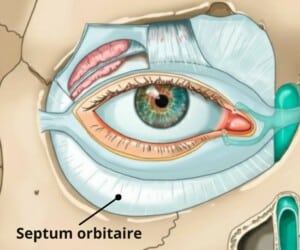
Orbital septum


Beneath this skin lies the orbital septum, A thin fibrous membrane that holds the orbital fat in place. Over time, this septum distends the fat moves forward, creating visible fat hernias. It is this fatty protrusion that forms the permanent bags under the eyes, Those that do not disappear with sleep or cosmetic care.


Around the eye and along the eyelid lies the orbicularis muscle. It closes the eye and contributes to eye tone. When the muscle relaxes, the eyelid can droop and the tissues can descend.

Understanding the function and tone of the orbicularis muscle is essential for choosing the right technique. blepharoplasty Simple fat removal, skin retention, or combined with a mid-third facelift.


WHAT EXACTLY IS AN UNDER-EYE BAG?


SIMPLE, VISUAL DEFINITION


A under-eye pocket is first and foremost a abnormal relief under the lower eyelid. Concretely, the area bulges, as if a small cushion had slipped under the skin. This swelling occurs when the supporting tissues become fragile: the fat that normally envelops the eye moves forward, sometimes combined with a little fluid. The natural contour of the eye is altered, and the transition from eyelid to cheek becomes less fluid.


POCKETS, SUITCASES AND RINGS: DON'T CONFUSE THEM ALL


True pockets correspond to this volume that stands out: you can almost draw the rounded shape. On the other hand, what is sometimes referred to as « suitcases »refers rather to a darkened hollow under the eye, associated with depression and/or hyperpigmentation of the skin: dark circles.

You can therefore have only puffiness, only dark circles, or both at the same time, which reinforces the impression of fatigue.

Distinguishing between relief and hollow is essential, because blepharoplasty treats excess volume, not color.


THE DIFFERENT PROFILES OF UNDER-EYE BAGS


Not all pockets behave in the same way.

Adipose pockets, due to a genuine excess or displacement of fat, are structural: they remain visible all day long, and often worsen over time or as a result of genetic factors.

In contrast, the water retention pockets or «morning bags» are linked to a temporary stagnation of fluid: they swell when you wake up, then deflate within a few hours when you start moving again.

Finally, there are lower pockets, known as malar pockets, located at the eyelid-cheekbone junction. They give a double-ringed effect and are often linked to lymphatic edema and ptosis of the middle third of the face.

Lower blepharoplasty mainly targets stable fat pockets; transient swelling or malar pockets require specific analysis and sometimes other types of treatment.


WHAT CAUSES EYES TO AGE?


FAT PROTRUSION: POCKETS THAT MOVE FORWARD


The first cause is fat protrusion. The medial, central and lateral fat pads migrate forward as the orbital septum loses its tension. Depending on which compartment is most affected, the pocket will be more visible near the nose, under the pupil or towards the outside of the eye. This precise mapping of the pockets enables the surgeon to remove or reposition the fat in a targeted manner, for a symmetrical and natural result.


SAGGING SKIN: SKIN THAT WRINKLES


Second major cause: sagging skin. Under the effect of sunfrom tobaccofrom stress and genetics, The skin loses its elasticity, stretches and forms excess skin. Horizontal wrinkles appear, and the eyelid takes on a crumpled appearance.

A lower blepharoplasty can then remove this excess skin in a measured way, to smooth the area without compromising eye closure.


MALAR DRIFT: THE DROOPING CHEEKBONE


Finally, malar drift, or ptosis of the middle third, It accentuates the aging of the eyes. The cheekbone As the eyelid descends, the tear valley deepens and the eyelid-jowl transition becomes more broken, increasing shadowing and the impression of puffiness. In these situations, a comprehensive treatment combining lower blepharoplasty, malar lift and sometimes facial lipofilling provides a more coherent rejuvenation than an isolated procedure on the eyelid alone.


DIFFERENTIATE BETWEEN PUFFINESS, DARK CIRCLES AND FURROWS

- Pockets under the eyes A stable relief under the lower eyelid, due to the advancement of fat in front of the septum; light breaks on this «bump» and creates a shadow.
- Pigmented rings brownish or purplish colored area of the skin, of genetic, vascular or inflammatory origin, without excess volume.
- Infraorbital groove A clear hollow between the eyelid and cheek, due to a lack of volume and sinking of the tissues.


WHAT A LOWER BLEPHAROPLASTY TREATS, AND WHAT IT DOESN'T


STRICT OPERATING INDICATIONS


Lower blepharoplasty treats fat pockets first isolated, When the orbital fat protrudes forward, simple filling or care is no longer enough. When orbital fat protrudes forward, simple filling or care is no longer sufficient. Removing or repositioning these fat pads can permanently reduce under-eye volume and smooth the eyelid.

The procedure also corrects excess skin moderate to marked. When the skin is slack and wrinkled, with numerous horizontal wrinkles, a measured skin resection is used to tighten the skin flap. The aim is to smooth the area without creating excessive tension, in order to maintain good palpebral closure and optimal ocular comfort.

Lastly, lower blepharoplasty can be integrated into a more global project of facial plastic surgery, This is particularly true in the presence of malar ptosis or marked deformity of the middle third. It may be associated with face lifting to harmonize the eye, cheekbone and tear trough and reduce the recurrence of puffiness.


WHAT AN INFERIOR BLEPHAROPLASTY WILL NEVER TREAT


Lower blepharoplasty does not treat pure pigmented dark circles. When the main problem is hyperpigmentation of the skin, whether genetic or post-inflammatory, removing fat or skin will not lighten the color. In these cases, dermatological treatments, peels and sometimes lasers or depigmenting treatments are preferred.

Similarly, eyelid surgery is no substitute for a healthy lifestyle. Lack of sleep, alcohol, an excessively salty diet, smoking or high levels of stress are conducive to edema and drawn features.

Blepharoplasty corrects a lasting anatomical deformity, not the one-off effect of a sleepless night. The patient needs to be aware of this shared responsibility, to keep expectations realistic.


WHEN TO AVOID OR DELAY LOWER BLEPHAROPLASTY


Certain ocular situations call for caution:

  • severe drought,
  • pre-existing ectropion (lower eyelid already turned outwards, leaving the eye too exposed)
  • closing disorders
  • unstabilized ocular pathology (glaucoma, infection, inflammation, retinopathy, etc.).


A history of poor healing or certain general illnesses may also lead to surgery being postponed.

That's the whole point of the preoperative consultation: to evaluate the benefit/risk balance and sometimes recommend options other than surgery.


HYALURONIC ACID, A RELEVANT MEDICAL ALTERNATIVE?


For young patients or for infraorbital hollows with no real pockethyaluronic acid injection dark circles can be a relevant alternative to blepharoplasty. Filling the gap valley of tears or the furrow between eyelid and cheek, reducing the shadow associated with the hollow and softening the tired appearance without incision or scarring. The procedure is performed in aesthetic medicine, following a precise medical examination.

This method does, however, have its limitations and specific risks. In the presence of real fatty pockets, hyaluronic acid can accentuate the relief rather than attenuate it.

The area is fragile: prolonged edema, irregularities and the Tyndall effect (bluish sheen) may occur. Exceptionally, serious vascular complications have been described. Hence the need to consult an experienced professional, capable of choosing between injection, lipofilling or blepharoplasty.


If you are hesitating between medical treatment, hyaluronic acid injections or surgery, an initial consultation at the doctor's office is recommended. Doctor Djian in Paris will enable us to accurately assess your case and define the most appropriate strategy.


LOWER BLEPHAROPLASTY: CHOOSING THE SURGICAL TECHNIQUE


TRANSCONJUNCTIVAL BLEPHAROPLASTY


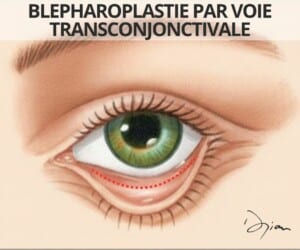
Transconjunctival lower blepharoplasty


The transconjunctival route involves passing through the inside of the lower eyelid. The incision is made over the conjunctiva, which makes the invisible scar on the skin. This technique is traditionally indicated when you wish to treat fatty pockets without noticeable excess skin. The surgeon gains direct access to the fat pads to remove or reposition them.

Recovery is generally faster than with a skin incision:

  • there is no external scarring,
  • ecchymosis is often more discreet
  • and more limited social discomfort.

In some cases, this pathway is associated with a slight « skin pinch »This can be achieved by using a "surface treatment" to correct minimal excess skin.


SUBCILIARY INFERIOR BLEPHAROPLASTY


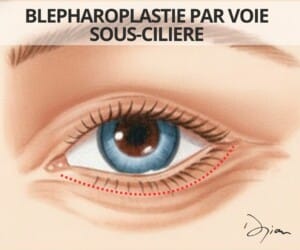
Lower blepharoplasty via the subciliary approach


The sub-channel route involves a incision flush with the lower eyelashes. The scar follows the ciliary line and becomes inconspicuous over time. This approach treats both fat and moderate to severe excess skin. The surgeon may remove or reposition fat, then resect excess skin to smooth the eyelid.

This route offers wide access to correct sagging skin, tighten the orbicularis muscle and improve eyelid-cheek continuity. On the other hand, the risk of visible scarring or eyelid retraction is slightly higher than with the transconjunctival approach. Hence the importance of a well-considered indication and mastered technique.


COMBINE LOWER AND UPPER BLEPHAROPLASTY


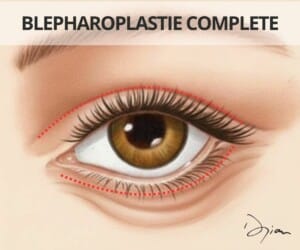
Complete blepharoplasty


In many cases, the sagging affects both the lower eyelid (bags, excess skin) and the upper eyelid (skin cap, weighed-down look). Combining lower blepharoplasty and upper blepharoplasty in the same operation means that the entire eye frame can be treated under a single anesthetic, with a shared recovery period. The eye is then opened at the top and smoothed at the bottom, offering a more homogeneous rejuvenation without altering the face's identity.


To find out if a simple lower blepharoplasty is sufficient or if an upper blepharoplasty should be associated, you can make an appointment at the office of the Docteur Djian in Paris for a personalized treatment plan.


HOW A LOWER BLEPHAROPLASTY PROCEDURE WORKS


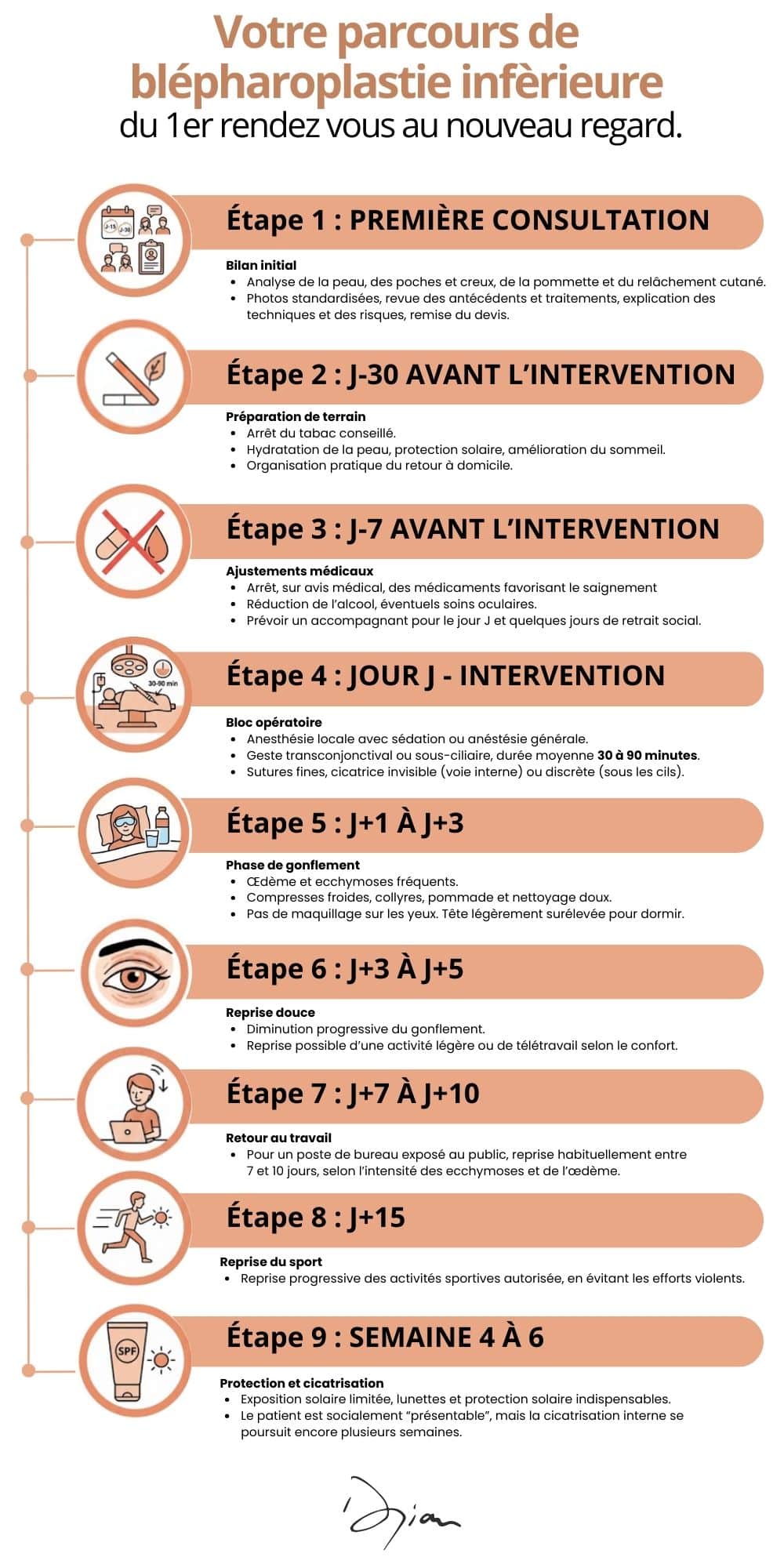
Your lower blepharoplasty course(10 x 20 cm)


PREOPERATIVE CONSULTATION


The first consultation is a time for detailed discussion and assessment. The surgeon

  • analyzes skin quality,
  • orbicularis muscle tone,
  • the presence of pockets or hollows,
  • cheekbone position
  • and the extent of any skin slackening.


Standardized photographs are taken to document the blepharoplasty project and monitor results.

Medical and ocular history, current treatments, allergies and lifestyle habits are reviewed. This is also the time to clarify your expectations, discuss the various techniques and present the benefits, risks and limitations of the procedure. Informed consent is signed after this comprehensive information.


PREOPERATIVE PREPARATION


Proper preparation reduces risks and improves healing. The surgeon and his team explain the measures to be taken concerning smoking, certain medications, the organization of the return home and the social management of the after-effects. A written pre-operative checklist helps you to find your way through the various stages leading up to surgery.


30 DAYS BEFORE


Approximately 30 days before surgery, smoking cessation is strongly recommended. Smoking increases the risk of complications, delayed healing and bruising. We also recommend optimizing skin condition through regular moisturizing, appropriate sun protection and, if necessary, specific skin care products. Good sleep hygiene helps reduce chronic edema.


7 DAYS BEFORE


The previous 7 days, certain medications that promote bleeding, such as NSAIDs or aspirin, are discontinued on medical advice. Avoid alcohol. Eye care can be initiated in cases of dryness or fragility. This is also a good time to organize the presence of a accompanying you on the day of the operation and to plan a few days of social retreat.


THE LOWER BLEPHAROPLASTY PROCEDURE


Lower blepharoplasty can be performed under local anaesthetic with sedation or general anaesthetic. The choice depends on the duration of the operation, the type of procedure (transconjunctival, subciliary, associated facelift) and the comfort required. The operation lasts an average of 30 to 90 minutes.

The sutures used are very fine, adapted to the palpebral area. In the transconjunctival approach, there is no visible scar on the skin. In the subciliary approach, the sutures are removed in consultation a few days later. The aim is to achieve discreet scarring, a natural look and perfectly preserved palpebral function.


IMMEDIATE AFTERMATH


In the days following the operation, a transient oedema is almost systematic. Eyelids appear swollen, sometimes asymmetrical at first. Localized ecchymoses are common, especially when the procedure is performed under the eyelids or in combination with a facelift. They gradually fade in one to two weeks.

Pain is generally moderate, and considered more as discomfort, a feeling of tension or tightness, than as acute pain. Simple analgesics are usually sufficient. Eye drops and ointments are prescribed to protect the ocular surface and reduce dryness. Sleeping with the head slightly elevated helps reduce swelling.


DAY D AND D+3


On the day of surgery and for the first three days, cold compresses are applied at regular intervals to limit swelling and bruising. Prescribed local care (eye drops, ointments, gentle cleansing) is essential to protect the surface of the eye and promote healing. Visit eye make-up is not recommended during this initial phase. A day-by-day post-operative timeline is often provided to visualize progress.


SOCIAL AND PROFESSIONAL RECOVERY


Resuming a light activity is possible usually between D+3 and D+5, depending on the level of bruising and swelling. For office work exposed to the public, we often recommend 7 to 10 days before full return.

Avoid sport for about 15 days to limit the risk of bleeding and swelling.

Sun exposure should be strictly limited for 4 to 6 weeks, The patient must wear sunglasses and apply appropriate protection. Even if the patient is presentable within a fortnight, deep scarring continues for several weeks.

Here's a visual timeline to help you anticipate each step and plan your social commitments.

If you would like structured support, from the first examination to social reintegration, Dr. Djian in Paris can offer you personalized follow-up care for your lower blepharoplasty.


LOWER BLEPHAROPLASTY: EXPECTED RESULTS, DURABILITY AND SURGICAL RISKS


MORPHOLOGICAL RESULTS


In morphological terms, lower blepharoplasty permanently reduces the volume of fatty pockets and redefines the lower eyelid line. The eye contour is sharper, the eyelid-cheek transition less broken, the relief under the eye less prominent. When excess skin is removed, the skin surface becomes smoother: fine folds and a wrinkled appearance recede, without altering the shape of the eye or the facial features.

After the procedure (generally after 3 months), before-and-after photos confirm the changes: less visible bags, more even lower eyelid, optically more open eyes. Recurrently, patients report being told that they «look better», that they appear «more radiant".« rested »or « less marked »The patient's family and friends are not always aware that eyelid surgery has been performed.


FUNCTIONAL RESULTS


The main aim of lower blepharoplasty is to improve aesthetic benefits. It generally has no major impact on the visual field, as the excess skin of the lower eyelid does not usually interfere with vision. On the other hand, patients often report a sensation of lightness, less skin tightness and greater eyelid comfort.

When surgery involves the upper eyelid, particularly in the case of annoying dermatochalasis, Skin reduction can improve an amputated visual field. This functional indication is the responsibility of upper blepharoplasty.

In all cases, ocular function is monitored during post-operative follow-up to ensure a result that is both aesthetically pleasing and comfortable.


STABILITY OVER TIME


Fat removed during lower blepharoplasty does not regrow. This explains the durability of the results achieved on fatty pockets. On the other hand, skin ageing and the gradual descent of facial tissues continue over the years. The appearance of the infra-orbital area may therefore continue to evolve, without this corresponding to a «regrowth» of the initial fat.

To prolong the benefits of the procedure, a healthy lifestyle is essential: daily sun protectionsmoking cessationskin hydrationlimiting weight variations. If new hollows appear or the skin becomes slack again over time, simple hyaluronic acid injections in Paris may be sufficient to maintain the result without necessarily resorting to further surgery.


FREQUENT SIDE EFFECTS AND LESS FREQUENT COMPLICATIONS


Common side effects include

  • edema,
  • bruises,
  • temporary asymmetry of swelling,
  • sometimes a sensation of dry eye or discomfort.


These manifestations are normal for the first few weeks gradually regress with care and time. Infections are rare, and limited by rigorous hygiene and well-structured post-operative follow-up.


More rarely, complications such as :

  • hypertrophic scarring in the subciliary tract,
  • retraction of the eyelid,
  • an ectropion
  • or malposition may occur.

More serious complications, such as retrobulbar hemorrhage with visual impairment, are still exceptional, but have been described.


These risks justify lower blepharoplasty being performed by an experienced plastic or reconstructive surgeon, in a suitable clinic, with careful post-operative follow-up.


PRICE OF A LOWER BLEPHAROPLASTY AND REIMBURSEMENT


The price of a lower blepharoplasty depends on several factors:

  • technique used,
  • type of anesthesia,
  • duration of the intervention,
  • possibly combined with an upper blepharoplasty or a cervico-facial lift


After a clinical examination and definition of the project, a personalized price indication is proposed, accompanied by a precise and detailed estimate.

In the absence of demonstrated functional repercussions, lower blepharoplasty is considered a cosmetic surgical procedure. It is therefore not not covered by Social Security, except in very special cases for reconstructive surgery.


BEFORE AND AFTER BLEPHAROPLASTY PHOTOS (LOWER AND UPPER)


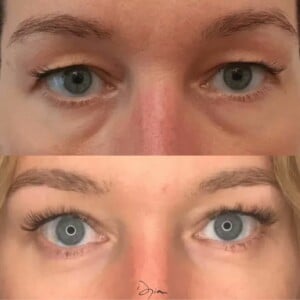
Before after Complete Blepharoplasty


Before and after photos of blepharoplasties help to visualize in concrete terms what a lower blepharoplasty, alone or combined with an upper blepharoplasty, can achieve. They show the reduction of bags, the smoothing of the eyelid, the correction of a heavy upper eyelid and the overall opening of the eyes.

It's important to bear in mind that only an individualized consultation can accurately assess the realistic result that can be expected.


RESTORE COHERENCE TO YOUR LOOK WITH LOWER BLEPHAROPLASTY


What a lower blepharoplasty really changes is not just the eyelid: it's the way you see yourself in the mirror every morning. No longer having to “camouflage” your bags, no longer hearing that you look tired when you feel great, it's a real comfort in everyday life.

The aim is not to transform you, but to bring your eyes back into line with your real energy, thanks to tailor-made cosmetic eyelid surgery (lower blepharoplasty alone, all 4 eyelids, or combined with a facelift depending on the case).

If you feel that your under-eye bags no longer look like you, the easiest thing to do is to talk about it. A consultation with Dr. Jérémy Djian in Paris allows you to make a clear diagnosis and explore your options with peace of mind.


Your Questions

FREQUENTLY ASKED QUESTIONS ABOUT LOWER BLEPHAROPLASTY

AT WHAT AGE IS LOWER EYELID SURGERY RELEVANT TO FACIAL AGING?

more less

There is no standard age for lower blepharoplasty. For some patients, under-eye bags are mainly genetic, appearing as early as age 30. In others, they appear around the age of 45-50 as the skin slackens. Surgery becomes relevant when bags are permanent, unpleasant and resistant to treatment or simple lifestyle changes.

WHAT IS THE DIFFERENCE BETWEEN A LOWER BLEPHAROPLASTY AND A HIGHER BLEPHAROPLASTY IN TERMS OF THE RESULT ON THE EYES?

more less
  • Lower blepharoplasty acts primarily on puffiness and sagging of the lower eyelid. It smoothes the under-eye area and softens the tired look of relief.
  • Upper blepharoplasty corrects the excess skin that falls onto the eye, the heavy eyelid, which sometimes impairs vision.
  • The 4-eyelid blepharoplasty opens up the whole eye, treating both the upper and lower parts, while respecting the face's natural expression.

WHO IS THE RIGHT CANDIDATE FOR A LOWER EYELID AESTHETIC PROCEDURE: YOUNG PATIENT, TIRED PERSON, LOOSE SKIN?

more less

The right candidate presents genuine bags under the eyes or a long-lasting excess of skin, as determined in a consultation. They may be young with a genetic component, or older with marked skin aging. What counts is the existence of a stable deformity, good general health and a clear motivation for blepharoplasty, with realistic expectations of the result.

WHAT TYPE OF ANESTHESIA IS USED FOR LOWER BLEPHAROPLASTY: LOCAL, LOCAL WITH SEDATION OR GENERAL?

more less

For isolated lower blepharoplasty, local anesthesia with sedation is often sufficient and very comfortable. In most cases, the patient wakes up quickly and can return home the same day. When several procedures are combined, such as an upper blepharoplasty, general anesthesia is often preferred for comfort and safety. The final choice is made in consultation with the anaesthetist, taking into account your medical history, your concerns and the expected duration of the procedure.

WHEN CAN I RETURN TO WORK AFTER LOWER BLEPHAROPLASTY?

more less

Resuming work depends above all on your social exposure and the type of activity. For office work with little exposure, some patients return to work between D+5 and D+7. For a job in constant contact with customers, ten days is often more comfortable, just long enough for the bruising and swelling to diminish. However, internal healing continues beyond that, over several weeks.

IS LOWER BLEPHAROPLASTY PAINFUL FOR THE FIRST FEW DAYS OR JUST UNCOMFORTABLE?

more less

In the vast majority of cases, lower blepharoplasty is described as little pain. Patients mainly report discomfort, tension or a pulling sensation in the eyelids, sometimes of tingling.

Simple analgesics are generally sufficient to control these symptoms. Swelling and bruising can be visually distracting, but do not represent intense pain. This period of’discomfort gradually decreases over 1 to 2 weeks, This is in line with swelling absorption.

WHY DO SOME PEOPLE NOTICE A RETURN OF PUFFINESS EVEN THOUGH THE FAT HAS BEEN REMOVED?

more less

What is often perceived as a« pocket return »In reality, "sagging" is the evolution of aging. The fat removed during blepharoplasty does not regrow, but the skin continues to sag, the cheekbone may droop and new hollows appear. Together, these can give the impression of puffiness. In some cases, minor medical touch-ups or surface treatments are all that's needed to reharmonize the area without further major surgery.

CAN LOWER BLEPHAROPLASTY BE COMBINED WITH A FACELIFT TO IMPROVE HARMONY?

more less

Yes, the combination of lower blepharoplasty and facelift is common when aging affects both the eyes and the oval of the face. Treating only the eyelids in a context of overall sagging can create a mismatch. The cervico-facial lift corrects ptosis of the tissues of the lower and middle face, while blepharoplasty treats bags and sagging eyelids. This combined approach ensures a more even improvement, provided it is well planned in consultation and adapted to your morphology, age and expectations.

What did you think of this article?

Rate it !

Average Rating 5 / 5. Number of Votes 2

No votes yet, be the first to rate this article.

Dr. Jérémy Djian
Dr. Jérémy Djian

Dr Jérémy Djian is a plastic surgeon based at 5 square Thiers, near the Victor Hugo roundabout, in the 16th arrondissement of Paris.

He trained in Paris and remains attached to the hospital in the prestigious department of Pr Laurent Lantieri.


Going further
THESE ITEMS CAN
IN THESE SECTIONS
Your Questions
ASK YOUR QUESTIONS
TO DR. DJIAN