



Dr. Djian is a plastic surgeon practicing rhinoplasty in Paris.

FREQUENTLY ASKED QUESTIONS ABOUT THE AQUILINE NOSE
How long does it take to recover from the removal of a nasal bump?
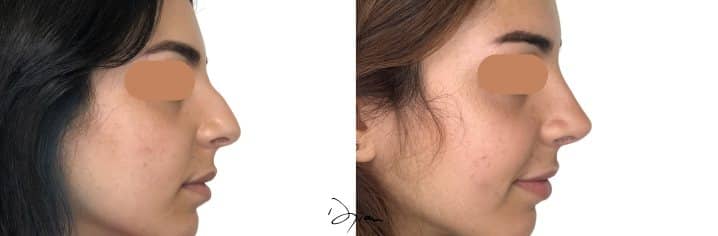
Although the first changes are visible within 10 days After the dressing is removed, patience is required. The swelling initially masks the contours of your new profile. If the nose begins to take shape 3 months, it is generally necessary to wait 12 months so that the tip is fully refined and the result of your aquiline nose is definitive.
Can the after-effects of an old broken nose be corrected?
Absolutely. Many patients consult us years after a trauma to correct a «traumatic bump» or a deviated nose. A secondary rhinoplasty remodels bone and cartilage to restore the original harmony of the face. Ultrasonic techniques are particularly effective here for reworking old bones.
At what age can you operate on an aquiline nose?
Surgical rhinoplasty is generally only performed not recommended until nasal growth is complete: around 16-17 years for girls and 18 years for boys. Surgery carried out before this physiological maturity may be compromised by the ongoing growth of cartilage and bone.
For minors, parental consent is required, and the patient's decision-making maturity is carefully assessed during the pre-operative consultation. There is no maximum age for rhinoplasty, provided the patient is in good general health. Medical rhinoplasty using injections can be considered at a slightly earlier age, but remains subject to individual medical assessment.
Do hyaluronic acid injections make the nose bigger?
It's a legitimate and often misunderstood fear. L’hyaluronic acid is a volumizing product It does not reduce the bump, it camouflages it by filling in hollow areas that surround it. By injecting above and below the bump, the practitioner creates a visually straighter profile line, but the overall volume of the nose may increase slightly. An experienced practitioner will dose the quantities injected very precisely to avoid this unwanted effect. For this reason, this technique should only be performed by a specialized physician, and not in a non-medical setting.
Can you lose your identity after an aquiline nose job?
This is the fear most often expressed by patients during pre-operative consultations, and it's a legitimate one. A serious surgeon never seeks to standardize a face or erase the character of a profile. The aim of modern rhinoplasty, particularly with preservation techniques, is precisely to preserve the nasal structures that give the face its identity, by correcting only what causes aesthetic or functional discomfort. The result should not resemble another nose, but a harmonized version of your own. A thorough consultation is the best way to remove this fear before making a decision.
Is aquiline nose surgery painful?
Rhinoplasty is performed under general anesthesia, so no pain is felt during the procedure. Post-operatively, discomfort is generally moderate and well controlled by appropriate analgesic treatment. Patients are more likely to describe feeling of pressure or nasal congestion than outright pain. The ultrasonic rhinoplasty, Thanks to its less traumatic effect on soft tissues, it is often associated with lighter post-operative effects. The vast majority of patients consider that recovery is well supported when they have been properly informed beforehand and prepared for this period.
Dr Jérémy Djian is a plastic surgeon based at 5 square Thiers, near the Victor Hugo roundabout, in the 16th arrondissement of Paris.
He trained in Paris and remains attached to the hospital in the prestigious department of Pr Laurent Lantieri.
IN THESE SECTIONS
TO DR. DJIAN