
fb All about ultrasonic rhinoplasty - Docteur DJIAN
Dr Jérémy Djian, 5 Square Thiers , 75016
menu close
Appointment appointment

Surgery

All about ultrasonic rhinoplasty

published on 15.03.2022 by Dr Djian
<noscript><img width=
Summary
  • WHAT IS ULTRASONIC RHINOPLASTY?
  • INDICATIONS AND ADVANTAGES OF ULTRASONIC RHINOPLASTY
  • HOW DOES THE PROCEDURE WORK?
  • HOW TO CHOOSE BETWEEN PRESERVATION RHINOPLASTY AND ULTRASONIC RHINOPLASTY?
  • WHAT ARE THE POST-OPERATIVE CONSEQUENCES OF RHINOSCULPTURE?
  • RESULTS OF ULTRASONIC RHINOPLASTY
In short
  • The ultrasonic rhinoplasty sculpts the bones and cartilage the nose using a vibrating instrument called a Piezotome.
  • It is ideal for correcting wide, irregular or deviated noses, with a precise surgical control.
  • The procedure is performed under general anesthesia, lasts approximately 3 hours and requires open path, causing a more pronounced swelling.
  • A external splint and internal silicone splints are worn during 7 to 10 days.
  • The recovery is fast: back to work after 1 week, sport après 6 weeks.
  • The results appear after 8 to 10 days, are refined in 1 to 3 months and become definitive after 12 to 18 months, with a rendering natural and harmonious.

Ultrasonic rhinoplasty, sometimes called structural rhinoplasty, is a technique that uses ultrasound equipment to shape the nose. Dr. Djian explains everything you need to know about this rhinoplasty technique. Dr. Djian performs only rhinoplasty preservation by closed channel.


WHAT IS ULTRASONIC RHINOPLASTY?


Ultrasonic rhinoplasty uses vibrations to shape and smooth the bones and cartilage of the nose.

The ultrasonic waves used to change the shape of the nose are produced by a device called an «ultrasound generator".« Piezotome ». Originally, this instrument was used to perform endo-buccal procedures (inside the mouth).

The Piezotome performs the same movements as conventional rhinoplasty instruments. The only difference is in the tool used. Here, instead of using manual osteotomes, the plastic surgeon uses vibrations to file, polish, drill holes or create breaks in cartilage and bone continuity.


INDICATIONS AND ADVANTAGES OF ULTRASONIC RHINOPLASTY


Ultrasonic rhinoplasty is mainly used to make changes to the back of the nose. This is particularly the case when the shape of the nose bone is irregular.


Advantages of ultrasonic rhinoplasty :


  • Optimal control of surgical procedures ;
  • Treatment of very wide noses
  • Treatment of noses with multiple traumas


The disadvantages of rhinosculpture


The main disadvantage of soft rhinoplasty is that it requires a large space to be created around the bone and cartilage structures. This space is required to insert and use the Piezotome.

The creation of this space leads to greater swelling in the weeks following the operation. Ultrasonic rhinoplasty can therefore only be performed openly.

Finally, the operation takes much longer than a conventional rhinoplasty. On average, it takes at least 3 hours. As a result, the cost of the operation is generally higher than for a closed rhinoplasty.

A cast or splint is applied, unlike in rhinoplasty, where a simple bandage is all that's needed.


HOW DOES THE PROCEDURE WORK?


The patient must arrive at the surgery site approximately two hours before the start of the procedure. He will then be placed under general anesthesia.

The surgeon then proceeds with preoperative marking.

The skin envelope is then separated from the structures nose bones. The skin is removed from the base of the nose (columella) and the side walls of the jawbones, up to the top of the cheeks.

  • In the case of a deviated septum (the piece of cartilage separating the two nostrils), the first step is to sculpt the septum. nasal septum so that it becomes straight and positioned in the middle of the nose.
  • In case of bump on the nose the hump is filed down using ultrasonic frequencies of the Piezotome. Bone and cartilage structures are polished in the same way.
  • To change the nose tip The tip is shaped by conforming the wing cartilages.


HOW TO CHOOSE BETWEEN PRESERVATION RHINOPLASTY AND ULTRASONIC RHINOPLASTY?


During a conventional rhinoplasty, the plastic surgeon manually cuts the bones using dedicated instruments known as osteotomes. These very fine instruments are capable of cut bones very precisely.

During ultrasonic rhinoplasty, the practitioner uses tools that deliver vibrations. These tools are mounted on handpieces and can also be used to cut bone.

There are no major differences in the operating procedure. The ultrasound instrument replaces manual instruments.

For choose between classic rhinoplasty and ultrasonic rhinoplasty, If you're interested in rhinosculpture, simply refer to the advantages and disadvantages of each technique. You can consult the advantages and disadvantages of rhinosculpture in the paragraphs above.

To find out more about the classic rhinoplasty known as «preservation», see our article « Rhinoplasty in Paris ».


WHAT ARE THE POST-OPERATIVE CONSEQUENCES OF RHINOSCULPTURE?


The suites post-operative The procedures involved in ultrasonic rhinoplasty are the same as those for conventional rhinoplasty. The only difference is that the swelling of the nose and face may be greater in «open» rhinoplasty.»

Post-operative hospitalization lasts just a few hours. If the patient is operated on in the morning, he or she will be discharged in the evening.

After the operation, an outer resin splint is placed over the nose. Soft silicone splints are placed inside the nose. The splints are worn for 7 to 10 days. They are removed by the surgeon.

Post-operative pain is very mild. Conventional analgesics such as paracetamol are sufficient to soothe the pain.

Swelling around the eyes can be observed for 3 to 5 days. Bruising lasts 8 to 10 days. A dark-rimmed appearance may persist for several weeks. Its appearance depends mainly on the type of skin.

After one week, you can return to work.

You will not be able to engage in any physical or aquatic activity for 6 weeks after the operation.


RESULTS OF ULTRASONIC RHINOPLASTY


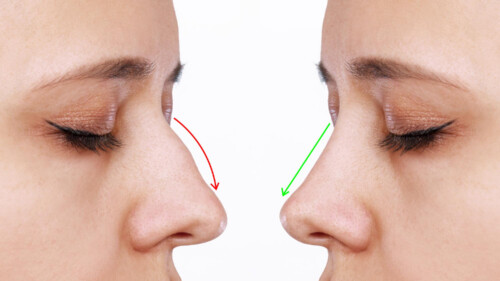
First profile results appear after 8 to 10 days, once the splints have been removed. Although the skin is still swollen, the nasal hump has disappeared and/or the nose is no longer deviated.

Results for the tip of the nose are visible after 1 to 3 months. The tip of the nose will then become finer and more defined. After 12 to 18 months, the final result can be observed. The result is natural and permanent.

However, if there is any asymmetry, this can easily be corrected.

Your Questions

FREQUENTLY ASKED QUESTIONS ABOUT ULTRASONIC RHINOPLASTY

ARE THERE MORE RISKS WITH ULTRASONIC RHINOPLASTY?

more less

No, ultrasonic rhinoplasty presents no more risk than a conventional technique, provided it is performed by an experienced surgeon. The Piezotome is extremely precise, limiting trauma to surrounding tissues. Serious complications are rare, but post-operative swelling can be more pronounced. Dr. Djian adapts the method to the patient's profile to ensure safety at every stage of the procedure.

IS ULTRASONIC RHINOPLASTY PAINFUL?

more less

No, ultrasonic rhinoplasty is painless. Thanks to the precision of ultrasound, the surrounding tissues are less traumatized, which reduces post-operative pain. Dr. Djian generally prescribes simple analgesics such as paracetamol. Sensations of tension or discomfort are common in the first few days, but acute pain is rare. General anaesthesia ensures a comfortable, pain-free operation.

CAN AN ULTRASONIC TECHNIQUE BE USED TO TREAT A TRAUMATIZED NOSE?

more less

Yes, ultrasonic rhinoplasty is particularly suitable for noses that have suffered trauma, with humps, deviations or bony irregularities. The Piezotome offers surgical precision for reshaping structures after fracture or previous surgery. Dr. Djian uses this technique to refine already affected areas without weakening them, particularly when bones are deformed or irregularly healed.

IS ULTRASONIC RHINOPLASTY SUITABLE FOR ALL PATIENTS?

more less

No, ultrasonic rhinoplasty is mainly indicated to correct a bony bump or asymmetry., However, it is not systematically suitable for very thick tips or purely cartilaginous noses. Dr. Djian evaluates the appropriateness of this technique on a case-by-case basis. For certain profiles, preservation rhinoplasty or a hybrid approach may be more appropriate to reduce edema and improve recovery.

What did you think of this article?

Rate it !

Average Rating 4.7 / 5. Number of Votes 32

No votes yet, be the first to rate this article.

Dr. Jérémy Djian
Dr. Jérémy Djian

Dr Jérémy Djian is a plastic surgeon based at 5 square Thiers, near the Victor Hugo roundabout, in the 16th arrondissement of Paris.

He trained in Paris and remains attached to the hospital in the prestigious department of Pr Laurent Lantieri.


Going further
THESE ITEMS CAN
IN THESE SECTIONS
Your Questions
ASK YOUR QUESTIONS
TO DR. DJIAN