
fb Adipomastia in men: from complex to solutions
Dr Jérémy Djian, 5 Square Thiers , 75016
menu close
Appointment appointment

Surgery

Adipomastia in men: excess breast fat and concrete solutions

published on 28.11.2025 by Dr Djian
<noscript><img width=
Summary
  • ADIPOMASTIA AND ITS IMPACT ON DAILY LIFE: PHYSICAL, PSYCHOLOGICAL AND SOCIAL DISCOMFORT
  • ADIPOMASTIA VS GYNECOMASTIA: DIFFERENCES, SIGNS AND DIAGNOSIS
  • ADIPOMASTIA: METABOLIC CAUSES, OVERWEIGHT, HORMONES AND RISK FACTORS
  • ADIPOMASTIA TREATMENTS: DIET, SPORT, LIPOSUCTION, SURGERY
  • ADIPOMASTIA CONSULTATION: CLINICAL EXAMINATION, ULTRASOUND AND TREATMENT PLAN
  • AFTER BREAST REDUCTION SURGERY: PAIN, HEALING, RETURN TO SPORTS, RESULTS
  • ADIPOMASTIA: SITUATIONS THAT CALL FOR PROMPT MEDICAL ATTENTION
  • WHAT IS THE PRICE OF ADIPOMASTIA IN PARIS AND WHAT DOES IT INCLUDE?
  • ADIPOMASTIA: KEY POINTS TO REMEMBER BEFORE TREATMENT
In short
  • Adipomastia is a form breast hypertrophy male characterized by a localized fat volume.
  • Sport can strengthen the pectoral muscle but does not remove excess fat.
  • The most effective option for correcting the breasts is the liposuction or targeted liposuction.
  • The gynecomastia requires surgical intervention to remove the gland.
  • Pricing, scarring and post-operative recovery depend on the clinical assessment and the surgeon.

ADIPOMASTIA AND ITS IMPACT ON DAILY LIFE: PHYSICAL, PSYCHOLOGICAL AND SOCIAL DISCOMFORT


THE GAZE OF OTHERS: SHIRTLESSNESS, CHANGING ROOM, BEACH


While some women are looking for a breast augmentation, a man with volume in his torso will be looking for just the opposite hide or delete it.

Being shirtless becomes a struggle. Locker room, beach, pool: you anticipate the gaze on your chest. T-shirts too large, shirts always closed, group photos avoided.

The problem isn't just aesthetic: it affects the way you represent yourself. In many people, discomfort dates back to adolescence, marked by humiliating remarks that are hard to forget.


INTIMACY AND SEXUALITY: AVOIDING BEING SEEN


In private, adipomastia, commonly known as « man boobs »It's even harder to live with. You prefer to keep your top up, turn off the light and avoid people touching your pecs. You're afraid of being judged, of being looked at with surprise, of being compared to a woman's breasts. Some men end up shunning sexual relations or love affairs because of this breast hypertrophy. It's not an aesthetic whim. It's a real psychological burden, related to an abnormal change in the appearance of the thorax.


SPORT AND BODYBUILDING: WHEN FAT DOESN'T GO AWAY


Cardio, weight training, diet... The face is slimmer, the belly smaller, but the chest remains. The muscle develops under the adipose tissue, but the breast volume persists. This dissociation between effort and visual result creates constant frustration: “it doesn't reflect the work I'm doing”. At this stage, adipomastia becomes a local problem that no longer responds to weight changes.


ADIPOMASTIA VS GYNECOMASTIA: DIFFERENCES, SIGNS AND DIAGNOSIS


ADIPOMASTIA: EXCESS BREAST FAT IN MEN


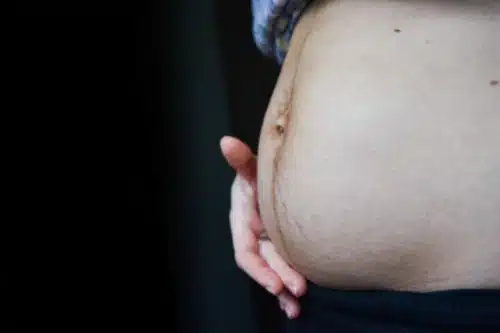
«How do I know if I have adipomastia?  »It's simple: adipomastia corresponds to an accumulation of fat around the breasts, with no significant excess of mammary gland. Volume is mainly adipose. To the touch, the area is soft, supple and diffuse, like a classic fat cluster. The appearance is often symmetrical, sometimes moderately asymmetrical. This form is common in cases of overweight, weight gain or a particular distribution of fat in the pectoral region. The heart of the problem is not the muscle, but the excess fatty tissue.


GYNECOMASTIA: DEVELOPMENT OF THE MAMMARY GLAND


Gynecomastia, on the other hand, corresponds to an abnormal development of the mammary gland. We're no longer talking about fat, but about denser glandular tissue.

To the touch, a harder lump is often felt, located behind the nipple or areola. It may feel sensitive, or even painful. There are glandular, fatty and mixed forms of gynecomastia.


MIXED CASES: FAT + GLAND


In many men, adipomastia and gynecomastia coexist. This is known as mixed gynecomastia: excess fat and glandular tissue combine. Breast volume is both adipose and glandular.

A detailed clinical examination, supplemented if necessary by an ultrasound scan and a hormone test in case of doubt, enables a precise diagnosis to be made and the appropriate treatment to be proposed: liposuction alone, gynecomastia cure or more complete male breast reduction with skin treatment.


ADIPOMASTIA: METABOLIC CAUSES, OVERWEIGHT, HORMONES AND RISK FACTORS


GENETIC DISTRIBUTION OF FAT IN THE THORAX


For some men, adipomastia is primarily a question of fat distribution. Your body stores fat more easily in the pectoral area than in other parts of the body. This characteristic may be linked to genetic factors, adipose tissue structure or skin quality.

ResultsA more visible and more difficult to accept fat in the chest.


HORMONES, AGE AND METABOLIC STORAGE


In adolescence hormonal variations are intense. Puberty triggers a increase in testosterone, But the endocrine system remains unstable. Many boys develop pubertal gynecomastia. It occurs between the ages of 12 and 16, and usually disappears between 12 and 36 months. It is a physiological phenomenon.

Overweight teenagers, fat amplifies the phenomenon. Adipose tissue produces aromatase, an enzyme that transforms part of the testosterone to estrogen. The imbalance androgens (hormones male”)/estrogen (“feminine” hormones) is accentuated and favours the fat storage in the chest area. Diffuse, soft adipomastia is then observed.

Storage is not always reversible. Even after weight loss in adulthood, the chest may retain a fat pocket because the adipocyte distribution has become fixed. Some people lose belly fat or thigh fat, but keep a persistent chest.

As we age, testosterone slowly declines, body fat increases more readily and the aromatase effect becomes more pronounced. The result is long-lasting adipomastia in some people, without any underlying hormonal disease.

If the increase in volume is rapid, occurs in a thin man or is accompanied by other signs (reduced libido, testicular disorders, taking certain treatments), a medical check-up with hormone analysis is useful to take stock.


DRUGS, DOPING PRODUCTS AND THEIR EFFECTS ON THE GLAND


Certain medications, doping or anabolic products sometimes lead to breast enlargement. They cause the mammary gland to expand, sometimes leading to an accumulation of fat in the breast area. The result is denser tissue, pain and changes to the areola.

It's important to tell your doctor or surgeon about these treatments. This will enable you to adapt your check-up, assess the hormonal component of the problem and integrate this factor into your choice of treatment.


ADIPOMASTIA TREATMENTS: DIET, SPORT, LIPOSUCTION, SURGERY


When exercise and diet are ineffective


In the first instance, the right reflex is simple: balanced diet, sugar and alcohol restriction, regular physical activity. This overall fat loss can refine the stomach, the face and sometimes slightly reduce the volume of the breasts.

In parallel, pectoral work improves posture, tone and shape of the torso. It does not remove an established local fatty mass, nor an actual mammary gland. If, after several months of serious effort and a stabilized weight, it's no longer a lack of exercise: you're looking at a adipomastie (grease) or a gynecomastia (gland).

At this stage, surgery becomes a rational option.


When surgery is unavoidable


When variations in weight, muscular training and lifestyle have no visible impact, the real anatomical cause of breast volume must be treated.

  • Isolated adipomastia : The right gesture is a targeted liposuction of the thorax,performed via small incisions concealed in a natural crease. It removes resistant fatty tissue and flattens the breasts. Scars are reduced and recovery is rapid.
  • Gynecomastia Treatment is a gynecomastia treatment, is the surgical removal of the mammary gland via a discreet incision at the lower edge of the areola. The result is long-lasting, as the glandular tissue does not grow back.
  • Mixed cases (fat + gland) Most men are in this situation. You need to combine liposuction for grease and removal of the gland to correct the entire volume. adipo-gynecomastia. If the skin is very distended, a skin gesture may be necessary to avoid an “empty” appearance.

The final decision is based on a clinical diagnosis and, if necessary, an ultrasound scan. The goal is not an “ideal” torso, but a realistic result: flat, more masculine breasts, consistent with your morphology.


ADIPOMASTIA CONSULTATION: CLINICAL EXAMINATION, ULTRASOUND AND TREATMENT PLAN


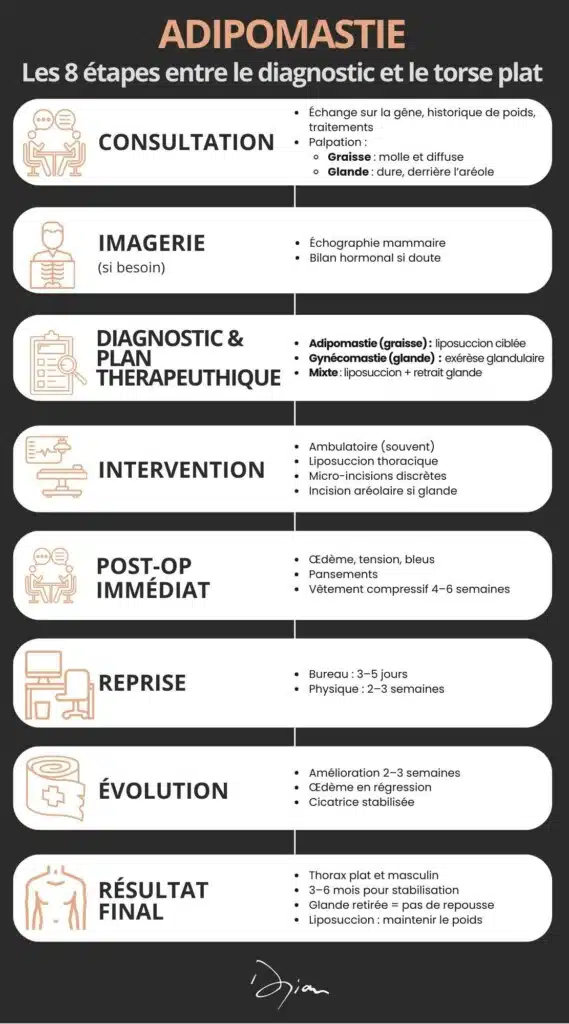
Adipomastie, from consultation to final result

CLINICAL EXAMINATION: VISIBLE FAT, GLANDS AND EXCESS


In a consultation, the surgeon begins by listening to you:

  • How long have breasts bothered you?
  • What weight variations have you experienced?
  • What medications are you taking?
  • What are your expectations?

Then he examines your chest: volume, symmetry, skin elasticity, degree of sagging, appearance of the areola and nipple. He will palpate to distinguish between fatty and glandular tissue. The surgeon will also ask for an endocrine check-up (to measure hormone levels).

This analysis enables us to determine whether the condition is adipomastia, gynecomastia or a mixed case, and to adapt the treatment.


ULTRASOUND: CONFIRM THE NATURE OF THE BREAST VOLUME


In certain situations, a breast ultrasound is recommended. It clarifies the distribution between fatty tissue and the mammary gland, and helps rule out a particular pathology.

Ultrasound complements the clinical examination, especially in case of significant asymmetry, pain or rapid development. It contributes to reliable diagnosis prior to surgery.

This pre-operative check-up is an essential element of safe male breast surgery that is consistent with your medical situation.


CARE: CHOOSING THE RIGHT TREATMENT FOR YOUR SITUATION


Once the assessment has been carried out, the plastic surgeon will present you with the various options: lifestyle changes, weight loss, liposuction, gynecomastia treatment, or simple monitoring.

It explains the duration of the procedure, the type of anesthesia (local or general), the location of scars, recovery time, possible risks and results. expected. It also addresses the question of possible coverage by health insurance.

If you'd like a specialist opinion, you can make a discreet appointment at Docteur Djian's practice in the 16th arrondissement of Paris, for a personalized assessment and a tailored treatment plan.


AFTER BREAST REDUCTION SURGERY: PAIN, HEALING, RETURN TO SPORTS, RESULTS


NORMAL DISCOMFORT, RESTRAINT AND RETURN TO ACTIVE LIFE


The days following an adipomastia or gynecomastia procedure are no picnic, but they're generally quite bearable, even for the fussiest patients. Most patients describe a sensation of «big aches and pains» rather than real acute pain. You may feel tightness in the chest, swelling and sometimes bruising, especially when changing position or lifting your arms. Painkillers are often prescribed to relieve this discomfort.

A support garment is fitted immediately after the operation. It supports the breasts, limits swelling and helps the skin to retract properly. In practice, it is often recommended to wear it day and night for about 4 weeks, Then another 1 to 2 weeks of daytime only, depending on your surgeon's advice and the progress of your edema.

The procedure is usually carried out on an outpatient basis Admission: morning admission, same-day discharge. An overnight stay is reserved for large volumes, high-risk patients or combined procedures (fat + gland + skin correction).

  • for office work, the majority of patients return to 3 to 5 days
  • for a trade physical (carrying loads, repetitive movements, straining arms): you need to 2 to 3 weeks, sometimes more, to avoid traction on scars, secondary bleeding or prolonged swelling.

If glandular exeresis is significant, or if a cutaneous procedure has been performed, the surgeon may recommend postponing the revision, as tension on the thorax delays healing and increases the risk of complications.


REDISCOVER YOUR BODY AND YOUR IMAGE


After removal of the fat and/or gland, the breasts cease to project a “feminine” volume and the chest regains a more virile contour. The concrete effect is psychological permanent pressure disappears.

Patients report that they can once again shower in the changing room without calculating their posture, take off their t-shirt at the beach, get dressed without layering, and have intercourse without keeping their top on.

The aim is not to beautify, but to remove an embarrassment that controls every social and intimate gesture.


RELAPSE PREVENTION: SPORT, SLEEP, NUTRITION


After a male breast reduction, it is advisable to stabilize your weight to limit the risk of further fat accumulation in the chest area. A sensible diet, regular physical activity and proper sleep are the pillars of a balanced lifestyle. These measures are not a military diet, but habits that support the surgical result.

Your surgeon will give you simple, realistic recommendations for maintaining your figure and comfort over the long term.


ADIPOMASTIA: SITUATIONS THAT CALL FOR PROMPT MEDICAL ATTENTION


Some signs are not consistent with simple fatty adipomastia and require prompt medical advice. Consult your doctor if you observe :

  • Unusual, persistent pain or palpable hard mass behind the areola: these symptoms are not typical of isolated excess fat and require clinical examination, sometimes supplemented by ultrasound.
  • Rapid volume increase on one side only or marked asymmetry This may reflect unilateral gynecomastia, a hormonal reaction or another pathology. Only a medical check-up can tell.
  • Nipple discharge (clear, bloody or milky) or sudden changes in the skin, areola or shape of the breast These signs should not be ignored and should be promptly assessed by a physician.

These signs do not necessarily imply a serious illness, but they do require a clinical examination to verify that it is not a pathology other than adipomastia. The more diagnosis is made early, the clearer and more reassuring the treatment options.

Don't be left alone with your concerns. Medical advice can often clarify the situation and point you in the right direction.


WHAT IS THE PRICE OF ADIPOMASTIA IN PARIS AND WHAT DOES IT INCLUDE?


The cost of an adipomastia correction starts at around 3000 €. This may seem like a lot of money, but you have to compare it to the invisible cost of your daily life: averting your gaze, avoiding the beach, choosing clothes to hide rather than to live in.

This price generally includes :

  • the operation,
  • the medical team and the OR,
  • post-operative checks,
  • follow-up to the final result

With an experienced cosmetic surgeon in Paris, you'll achieve a real and lasting improvement in your silhouette. This is the moment when discomfort ceases to have the last word.


ADIPOMASTIA: KEY POINTS TO REMEMBER BEFORE TREATMENT


Adipomastia is common and largely underestimated. Many men live with this situation in silence, between shame, ego and incomprehension. It's not a question of a lack of willpower, but of a lack of willpower. localized excess fat, sometimes combined with a abnormal development of the mammary gland. Putting a word to what you have and knowing the treatment solutions helps to breaking the taboo and regain control of your body.

The key is a clear diagnosis. A clinical examination allows you to differentiating between adipomastia, pure gynecomastia and mixed forms. We assess breast volume, the distribution of fatty and glandular tissue, skin quality and possible hormonal factors. This diagnosis makes it possible to guide you towards the right treatment.

If you are looking for specialist advice at Paris, Doctor Djian will work with you to find the right solution.

You're not not obliged to decide alone or in a hurry. You can ask questions, compare options, request a quote and consider the risk/benefit ratio.


Your Questions

FREQUENTLY ASKED QUESTIONS ABOUT ADIPOMASTIA

IS ADIPOMASTIA A SERIOUS DISEASE?

more less

Adipomastia is not a serious disease. It's an excess of fat localized in the thorax, responsible for aesthetic and psychological discomfort. Unusual pain, a hard lump or a rapid change in appearance call for a medical examination to rule out another cause.

DOES BREAST LIPOSUCTION LEAVE LARGE SCARS?

more less

Isolated adipomastia, Liposuction is performed through small incisions of around 4 mm, placed in a natural crease. Scars are inconspicuous after the procedure.

If a mammary gland is removed, a small incision at the lower edge of the areola may be necessary.

DOES PECTORAL FAT DISAPPEAR WITH SPORT AND DIET?

more less

Sometimes partially. Overall weight loss can reduce chest fat. But many men retain localized fat despite good weight control. In this case, the problem is anatomical and treatment becomes surgical if the discomfort is real.

IS THE ADIPOMASTIA PROCEDURE REIMBURSED BY SOCIAL SECURITY?

more less

Purely cosmetic breast reduction for adipomastia is not covered by social security.

However, certain forms of gynecomastia with abnormal mammary gland development, painful symptoms or real associated pathology may benefit from partial coverage, under certain conditions.

During the consultation, the surgeon studies your file, checks whether there is a recognized medical indication and gives you a quote specifying the fees and the portion that may be reimbursed.

HOW TO CHOOSE AN AESTHETIC SURGEON SPECIALIZING IN ADIPOMASTIA IN FRANCE?

more less
  • Check that it is registered in the Council of the Order in plastic, reconstructive and aesthetic surgery.
  • Request sound annual volume of adipomasties/gynecomasties.
  • Analysis of real before/after.
  • Requires clear consultation on risks, scars and limits.
  • Avoid promises and “miracle” prizes.

CAN ADIPOMASTIA CONTRACTED IN ADOLESCENCE PERSIST INTO ADULTHOOD?

more less

Yes, in some men, the chest fat deposited at puberty does not disappear despite sport or weight loss. It may persist into adulthood, requiring targeted surgical treatment.

WHY DON'T PECTORAL EXERCISES REDUCE BREAST FAT?

more less

Weight training increases muscle, not local fat burning. The body eliminates fat globally. Even with good pectoral muscles, a stubborn chest bulge persists. The problem is anatomical, not sporting.

AT WHAT AGE CAN ADIPOMASTIA SURGERY BE PERFORMED?

more less

Surgery is possible from the end of puberty, when volume is stable and breast development no longer varies. In practice, most surgeons operate from the age of 17-18.

What did you think of this article?

Rate it !

Average Rating 5 / 5. Number of Votes 1

No votes yet, be the first to rate this article.

Dr. Jérémy Djian
Dr. Jérémy Djian

Dr Jérémy Djian is a plastic surgeon based at 5 square Thiers, near the Victor Hugo roundabout, in the 16th arrondissement of Paris.

He trained in Paris and remains attached to the hospital in the prestigious department of Pr Laurent Lantieri.


Going further
THESE ITEMS CAN
IN THESE SECTIONS
Your Questions
ASK YOUR QUESTIONS
TO DR. DJIAN