

fb Breast lift after sleeve, how is it managed?
Dr Jérémy Djian, 5 Square Thiers , 75016
menu close
Appointment appointment
Price

Breast Lift and Treatment: What Medicare Covers (and What You'll Have to Pay)

Published on May 26, 2026 by Dr. Djian
Breast lift surgery and coverage: what Medicare covers (and what you'll have to pay out of pocket)
Summary
  • CAUSES OF PTOSIS: PREGNANCY, AGE, AND WEIGHT FLUCTUATIONS
  • MEDICAL CONDITIONS AND CRITERIA: HOW TO GET A REFUND?
  • BREAST LIFT AFTER BARIATRIC SURGERY: WHY IT'S NEARLY IMPOSSIBLE TO GET COVERAGE
  • WHEN SHOULD YOU CONSIDER A BREAST LIFT? THE RIGHT TIME FOR SURGERY
  • MAKE AN APPOINTMENT WITH DR. DJIAN IN PARIS
In short
  • A breast lift is considered a plastic surgery : The CPAM does not reimburse this by default.
  • A associated breast reduction, with withdrawal of more than 300 g per breast, may entitle you to a refund.
  • Congenital malformation or major asymmetry : two other situations that qualify for partial coverage.
  • After sleeve gastrectomy or gastric bypass surgery, breast lift surgery is not covered by insurance in almost all cases.
  • Only a surgeon can check your eligibility to receive care and put together your file.

Are you considering a breast lift in Paris ((breast lift) for correct sagging breasts and you're wondering if Social Security will cover all or part of the costs? The short answer: rarely, but not always. Correction of breast ptosis is considered a procedure for plastic surgery, so it is not reimbursed by default. However, there are specific situations in which partial coverage is available, especially after a significant breast reduction or a bariatric surgery. This guide provides an overview of each case, the specific criteria, and what you are responsible for paying.


CAUSES OF PTOSIS: PREGNANCY, AGE, AND WEIGHT FLUCTUATIONS


The breast is composed of mammary gland tissue, fat, and skin. When the skin stretches without the internal volume increasing accordingly, the breast sags: this is breast ptosis. There are many reasons for this.

  • Congenital ptosis. It can appear as early as adolescence, sometimes accompanied by asymmetry or tuberous breasts, birth defects that often cause severe self-esteem issues and may warrant medical intervention.
  • Breast enlargement. This is the most common cause. Excess breast volume stretches the skin until it sags. A breast reduction of more than 300 grams per breast may, in such cases, entitle the customer to a refund.
  • Pregnancy and breastfeeding. The stretching of the breast skin follows the same mechanism as thebreast hypertrophy, often with residual ptosis after breastfeeding.
  • Weight loss. Fat loss causes the breasts to sag before the skin has time to tighten up. This is colloquially referred to as «washcloth breasts.» This condition is particularly common after a sleeve gastrectomy or gastric bypass.
  • Age. The skin loses its elasticity, fat accumulates in the breast tissue, and the breast’s shape gradually disappears.


DID YOU KNOW?
+7.2 percentage points per year : This is the estimated annual global growth rate for the number of breast lifts through 2033.


MEDICAL CONDITIONS AND CRITERIA: HOW TO GET A REIMBURSEMENT?


Correction of breast ptosis is generally considered a purely cosmetic surgical procedure. A breast lift alone is therefore not covered by Medicare, regardless of the psychological impact this may have.


The strict requirements of Medicare for a breast lift


Partial coverage by Medicare is available in two situations:

  • Breast reduction combined with a breast lift, with more than 300 grams removed from each breast.

These 300 grams may consist of fat or mammary gland tissue. The procedure then takes on a different nature: we refer to breast reduction, listed differently (QEMA013, SS base: approximately €408). This volume corresponds to approximately 1 to 2 cup sizes smaller. The procedure is performed under general anesthesia. When such a large amount of tissue is removed, there is often excess skin that the surgeon must address with a breast lift.

When these conditions are met, prior approval from the medical advisor is not required: coverage is automatic.

  • Congenital malformation with significant asymmetry. 

Hypoplasia mammary, tuberous breasts, chest deformity (Poland syndrome): These situations may also qualify for coverage by Social Security, which is reviewed on a case-by-case basis.

Having sagging breasts without excessive volume does not, in and of itself, qualify as a criterion for reimbursement.


Reimbursement basis and out-of-pocket costs: fees and clinic expenses


Even if the costs are covered, the partial refund.

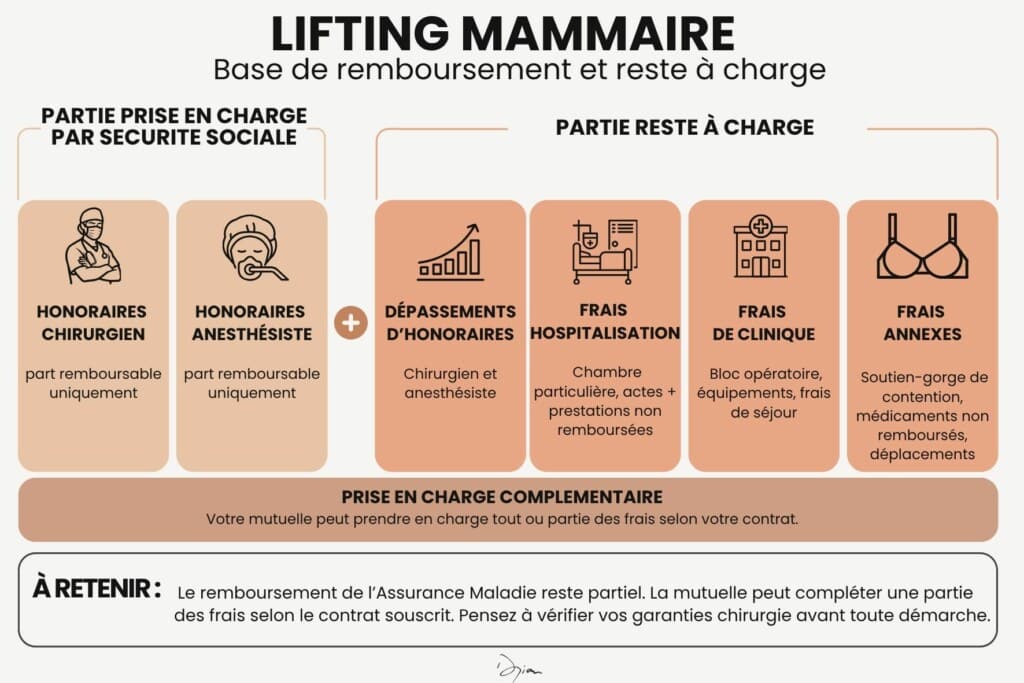
Social Security covers part of the surgeon's fees and the’anesthesiologist based on the official fee schedule.

The excess fees, the hospitalization costs and clinic fees are the patient's responsibility.

Your supplemental health insurance may cover all or part of these costs, depending on your policy. It is essential to check your surgery coverage before taking any action.

Breast lift: covered portion and out-of-pocket costs


BREAST LIFT AFTER BARIATRIC SURGERY: WHY IT'S NEARLY IMPOSSIBLE TO GET COVERAGE


After a sleeve gastrectomy or a bypass, breast ptosis is common and often severe. Unlike abdominoplasty, Although sometimes covered after bariatric surgery, a breast lift remains, in almost all cases, a cosmetic surgery procedure at 100 %, even after significant weight loss.


Why are breasts excluded from reimbursement criteria?


The CPAM reimburses breast reduction surgery only if more than 300 grams of tissue are removed per breast. However, after significant weight loss, the breasts lose their fat : what remains is essentially excess skin, which weighs very little. The 300-gram threshold is therefore rarely reached. A mastopexy corrects excess skin, not excess volume, which excludes it from the scope of corrective surgery. Mutual insurance companies also do not cover costs without prior approval from Social Security.


The rare exceptions


Coverage is still available in two cases: actual extraction of more than 300 g per breast (exceptional post-bariatric) or significant breast asymmetry and documented congenital malformation. Except in these situations, no administrative procedure will result in a refund.


Solutions for ineligible patients


There are two options for treating ptosis and restoring volume: the breast lift with breast implants or the breast lift with breast lipofilling. The patient is responsible for the full cost of these procedures. In all cases, a It is essential to maintain a stable weight for at least 12 months before undergoing surgery.


Combining a breast lift with other post-bariatric surgeries


When a breast lift is performed at the same time as a covered tummy tuck, the items are listed separately. The total duration of the procedure affects anesthesia costs, a factor that should be taken into account in the estimate. Combining procedures into a single operation is often the most sensible approach from both a medical and economic standpoint.


WHEN SHOULD YOU CONSIDER A BREAST LIFT? THE RIGHT TIME FOR SURGERY


A breast lift performed before your weight has stabilized does not guarantee long-lasting results. If your weight fluctuates again, your breasts may sag. It is therefore recommended that you wait at least 12 months for your weight to stabilize before considering breast surgery.

Depending on the anatomy and the desired outcome, several surgical techniques are available:

  • Breast lift alone. 

Removal of excess skin with repositioning of the areola. The inverted T-shaped scar (mariner's knot) is the most commonly used technique. In cases of moderate ptosis, a single scar around the areola (round block) may be sufficient.

  • Breast lift with breast implants.

When weight loss has caused the breasts to sag and there is no excess fat to remove, breast implants can restore breast volume while lifting the breasts.

  • Breast lift with breast lipofilling.

Injecting fat harvested from another part of the body allows for a natural increase in breast volume and restores their shape, without the use of implants.


MAKE AN APPOINTMENT WITH DR. DJIAN IN PARIS


Coverage for a breast lift depends on specific medical criteria that only a clinical examination can assess. Whether you are dealing with breast enlargement, sagging breasts after pregnancy, or weight loss following a sleeve gastrectomy, it is essential to consult a plastic surgeon in Paris in order to assess your situation on an individual basis and guide you toward the most appropriate solution for breast lift surgery, both medically and administratively.

Consult with Dr. Djian to find out if you are eligible for coverage and to get a personalized quote.


Source: https://univdatos.com/reports/mastopexy-market (Last updated May 2025)

Your Questions

FREQUENTLY ASKED QUESTIONS ABOUT BREAST LIFT

How much does a purely cosmetic breast lift cost without insurance coverage?

more less

If insurance does not cover the cost, the price for a breast lift (without implants) with Dr. Djian starts at 6 500 €, including the surgeon’s and anesthesiologist’s fees, as well as operating room costs. This cost may vary depending on the procedures performed (implant placement, correction of asymmetry, breast lipofilling).

Does my health insurance cover the surgeon's extra fees?

more less

Yes, but only if the procedure is covered by Social Security. The The health insurance plan provides supplemental coverage based on the official rate schedule set at €408.38 for a bilateral breast reduction. Specifically, a health insurance plan with a 300 % coverage level reimburses 3 × €408.38 = 1 225 €, compared to just 408 € for a health insurance plan covering 100% of costs. Given that actual fees can exceed €3,000 in Paris, the coverage level of your supplemental insurance is crucial. Send the detailed quote to your health insurance provider before the procedure to estimate your out-of-pocket costs.

The CPAM has denied my request for prior approval: what can I do?

more less

A denial by the CPAM is not final. You can appeal to the Amicable Appeals Commission (CRA) from your health insurance provider within two months of receiving notice of denial. If the CRA confirms the denial, you may appeal the decision to the Health Insurance Ombudsman, and then, as a last resort, before the Social Division of the Judicial Court. To maximize your chances, your case must be supported by specific medical documentation provided by your surgeon. Consult with Dr. Djian to determine whether your case warrants an appeal and which documents should be strengthened.

I have significant breast asymmetry following a pregnancy. Am I eligible for coverage?

more less

A Breast asymmetry may qualify for coverage if it is sufficiently pronounced; generally a a difference of at least two cup sizes between the two breasts. In this case, the procedure is considered reconstructive rather than purely cosmetic. However, pregnancy itself is not a criterion for reimbursement: it is the objective degree of asymmetry that is assessed by the medical advisor. A consultation with a specialized surgeon is essential to document the asymmetry, compile the case file, and submit a request for prior authorization to the CPAM.

Can you get coverage if you have back pain caused by the size of your breasts?

more less

Yes, the back or neck pain associated with confirmed breast hypertrophy constitute a strong medical justification to justify coverage for breast reduction surgery. However, Social Security considers the procedure to be reconstructive if the volume removed exceeds 300 grams per breast and the disproportion between breast volume and body shape is objectively demonstrated. Studies show that more than 70% of patients report a significant reduction in pain following reduction surgery.

How long does it take for the CPAM to respond to a request for prior approval?

more less

The CPAM is legally authorized to 15 calendar days to respond within a certain period of time from the date of receipt of the application. If no response is received within this period, approval is deemed to have been granted by default. In the event of a denial, you will receive a notification letter outlining your options for appeal. It is recommended that you Submit the application at least 3 to 4 weeks before the surgery to avoid having to make multiple trips to the insurance company. The medical advisor may also schedule a clinical examination with the patient before making a decision.

What did you think of this article?

Rate it !

Average Rating 4.4 / 5. Number of Votes 25

No votes yet, be the first to rate this article.

Dr. Jérémy Djian
Dr. Jérémy Djian

Dr Jérémy Djian is a plastic surgeon based at 5 square Thiers, near the Victor Hugo roundabout, in the 16th arrondissement of Paris.

He trained in Paris and remains attached to the hospital in the prestigious department of Pr Laurent Lantieri.


Going further
THESE ITEMS CAN
IN THESE SECTIONS
Your Questions
ASK YOUR QUESTIONS
TO DR. DJIAN
Euridyce
April 17, 2021

Hello,
I'm considering a breast lift combined with a breast augmentation following major weight loss.
Being of West Indian origin (black skin), I'm afraid I'll have poor healing, which will be too visible afterwards.
Is T-shaped healing the only option?
Thanks in advance

answer
Dr Djian

Hello, ma'am,
you need to be examined
in very specific cases, a single scar can be made around the breast
to improve scarring, a laser (urgotouch) can be applied during surgery
sincerely

Sara
05.11.2020

Hello,

After a weight loss of 30kg, I lost a lot of breast (I was 85E in size).
Today my breasts are sagging and above all I have a lot of excess skin.
I can't wear low-cut tops because of all the “folded” skin you can see, and it hinders me in my daily activities, in sport, and above all psychologically, at 23, it's very hard.
If I've understood correctly, health insurance doesn't cover this, but are there any special cases? The 300 grams are not expected with the excess skin to be removed? Can't a good mutual insurance company take care of that either?
Honestly, I understand that there are worse things, and that a sagging bust is not an urgent case for social security, but to have no breasts (because for me, no, the one I have is not a breast) but only excess skin in a bra, is physically and psychologically disabling.
So I'd like to know more, please.

Thank you in advance

Best regards,

Sara

answer
Dr Djian

Hello, ma'am,

Unfortunately, the skin weighs next to nothing (maybe 50 grams).
I understand your distress, but I don't legislate social security.

I remain at your disposal, however,

Dr Djian

Farah
September 25, 2020

Hello,

I have a breast that is a different size to the other, it was quite obvious, I had prostheses fitted in order to solve this problem in Venezuela, at the time there were the famous PIP that I still wear, in addition it has greatly interfered with breastfeeding my child, in short all this means that I would like to have the prostheses removed and correct the difference in size, would there be a way to justify this medically for coverage by the social security? Thank you.

answer
Dr Djian

Hello, ma'am,

If the prostheses are removed without fitting new ones, and without any associated procedure (breast lift), reimbursement is possible.
Nevertheless, the result won't be great.

In the case of implant changes and facelifts, this is not covered.

In any case, you should be examined before making a decision.

Yours sincerely

Diakite
August 13, 2020

Hello
I have had 3 children and my breasts are very damaged and fall off a lot. .
I would like to know if the operation can be covered by the health insurance. .
I look forward to hearing from you.

answer
Dr Djian

Hello, ma'am,

Unfortunately not, if you've read this article you'll have the explanation (> 300 g of breast).

Yours sincerely,

Dr Djian