


Breast Augmentation with Implants
L'augmentation mammaire par prothèse consiste à insérer un implant en gel de silicone cohésif derrière ou devant le muscle pectoral, pour augmenter le volume et remodeler la silhouette de la poitrine. Contrairement au lipofilling mammaire, qui repose sur un transfert de graisse propre à la patiente, l'augmentation par prothèse offre un résultat plus prévisible. Le gain de volume y est aussi plus important, généralement de 1 à 3 tailles de bonnet. C'est l'une des chirurgies esthétiques les plus pratiquées au monde chez les femmes. Grâce à une large gamme d'implants et à des techniques de positionnement précises, les résultats sont naturels et durables. Le Dr Jérémy Djian vous accompagne à chaque étape, du choix des implants jusqu'à la récupération.
- Thebreast augmentation by implant is a short surgical procedure performed under outpatient general anesthesia.
- The choice between round implant and anatomical depends on the patient's body type and the natural-looking result she is seeking.
- The dual-plane technique, which Dr. Djian prefers, provides optimal muscle coverage and a natural contour.
- There are three incision sites; the scar is barely noticeable and fades within 12 to 18 months.
- Health Insurance covers the procedure in certain medical conditions (reconstruction, breast asymmetry importante,…)
QU’EST-CE QU’UNE AUGMENTATION MAMMAIRE PAR PROTHÈSE ?
Thebreast augmentation in Paris est une intervention chirurgicale visant à augmenter le volume de la poitrine et à remodeler la silhouette. Elle répond à des objectifs à la fois esthétiques et médicaux : corriger une breast hypotrophy, handle a breast agenesis or Breast Reconstruction After Cancer.
Dans tous les cas, la finalité reste la même : obtenir une poitrine harmonieuse, proportionnée et d’apparence naturelle.
L’intervention permet généralement de gagner 1 à 3 tailles de bonnet, depending on the volume of the implant chosen and the patient's body type.
WHEN SHOULD BREAST IMPLANTS BE PLACED?
The breast surgery Implant-based treatment is indicated in several distinct clinical situations.
L‘breast hypoplasia’ is the most common reason: breasts are perceived as too small relative to body size general. A marked asymmetry, a breast ptosis modérée ou une perte de volume après grossesse or breastfeeding constituent également des indications valides. Certaines malformations, comme les tuberous breasts, en font aussi partie.
Enfin, la pose d’implants est également indiquée dans le cadre d’une breast reconstruction après un cancer du sein. Lorsque la patiente ne dispose pas de réserves de graisse suffisantes pour un breast lipofilling in Paris, elle reste la solution de référence.
CHOOSING BREAST IMPLANTS: TYPES, SHAPES, AND SIZES
ROUND OR ANATOMICAL IMPLANTS: WHICH ONE SHOULD YOU CHOOSE?
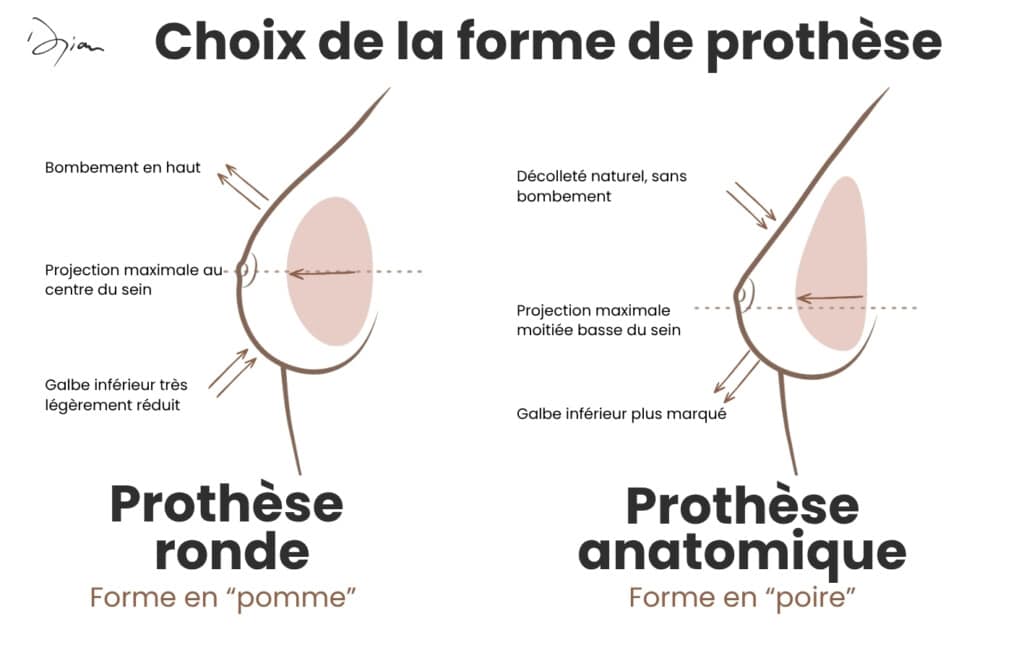
The choice of implant is a personal decision, guided by the desired outcome, the patient’s body type, and the quality of her breast tissue. There is no one-size-fits-all answer: the surgeon’s recommendation is based on the patient’s goals.
Implant rond vs implant anatomique
| Criteria | Implant rond | Implant anatomique |
|---|---|---|
| Forme | Volume réparti de façon homogène | Forme « goutte d’eau », plus de volume en bas |
| Décolleté | Plus marqué | Transition douce vers le haut |
| Projection | Centrée | Progressive, naturelle |
| Rendu | Poitrine bien visible, résultat affirmé | Quasi indiscernable d’une poitrine naturelle |
| Indication | Patiente souhaitant un résultat affirmé | Patiente recherchant une augmentation discrète |
In both cases, the final decision will be made during the consultation, taking into account your anatomy, your goals, and Dr. Djian’s recommendations.
SILICONE GEL IMPLANTS: ARE THEY SAFE AND DO THEY FEEL NATURAL?
Les implants mammaires actuels sont composés d’une enveloppe en silicone remplie d’un gel dit cohésif. Ce terme désigne un gel dont les molécules sont fortement liées entre elles.
In case of rupture de la membrane, le gel reste en place et ne migre pas dans les tissus environnants. Cela le distingue des anciennes générations d’implants, plus exposées à ce risque.
Les implants utilisés par le Dr Djian sont des dispositifs médicaux certifiés CE, soumis à une réglementation stricte.
WHAT IMPLANT SIZE IS RIGHT FOR MY BODY TYPE?
The volume of the implant is measured in cubic centimeters (cc), not directly in cup size. The choice of the breast implant size is based on several criteria:
- the width of the thoracic base,
- the thickness du tissu mammaire existant,
- The weight
- the morphology General.
An implant that is too large for a narrow chest base can lead to an unnatural-looking result and long-term complications. During the consultation, Dr. Djian suggests trying on different sizes in a bra—a simple and very effective method to help the patient visualize the expected result before making any decisions.
SURGICAL TECHNIQUES: SCARS, INCISIONS, AND IMPLANT POSITION
WHERE ARE THE SCARS LOCATED AFTER BREAST IMPLANT SURGERY?
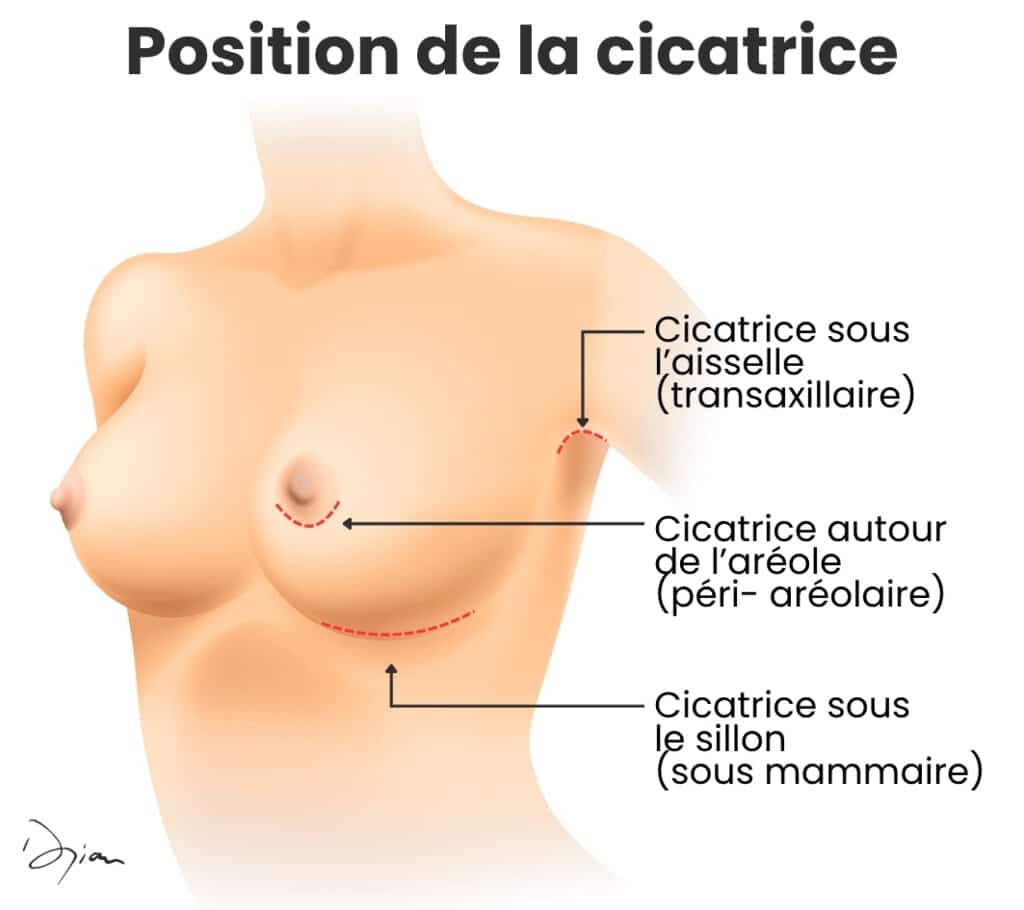
| Voie d’abord | Emplacement de la cicatrice | Avantage principal | Limite |
|---|---|---|---|
| Sillon sous-mammaire | Pli naturel sous le sein | Cicatrice discrète, dissimulée dans le pli | - |
| Areolar | Bord inférieur de l’aréole | Se fond dans la texture de l’aréole | Nécessite une aréole suffisamment large |
| Axillary | Aisselle | Aucune cicatrice visible sur le sein | Accès chirurgical limité, peu utilisé en France |
There are three possible approaches for inserting the implant.
- The inframammary fold approach consiste en une incision dans le pli naturel sous le sein. La cicatrice y est discrète, car masquée par ce pli.
- The areolar pathway place l’incision sur le bord inférieur de l’aréole, à la jonction entre la peau pigmentée et la peau normale. La cicatrice se fond alors dans la texture de l’aréole.
- The axillary route, par l’aisselle, évite toute cicatrice visible sur le sein, mais elle limite l’accès chirurgical. Elle est aujourd’hui peu utilisée en France.
PLEASE NOTE
Dr. Djian prefers the inframammary incision because of its precision and the quality of healing it provides.
IMPLANT POSITION: IN FRONT OF OR BEHIND THE PECTORAL MUSCLE?
Patients often wonder: How will the breast implant, in front of or behind the muscle ? In fact, the implant can be positioned along three anatomical planes:
| Position | Emplacement | Avantage principal | Indication |
|---|---|---|---|
| Pré-pectorale (devant le muscle) |
Sous la glande mammaire | Technique plus simple | Tissu mammaire suffisant |
| Rétro-musculaire (derrière le muscle) |
Sous le muscle grand pectoral | Meilleure couverture, moins de risque de palpation, rendu plus naturel | Morphologies minces |
| Dual plan (privilégiée par le Dr Djian) |
Haut sous le muscle / bas sous la glande | Couverture optimale en haut + projection naturelle en bas | Combine les deux approches précédentes |
- In the prepectoral position (in front of the muscle), it is placed directly beneath the mammary gland. This technique is suitable for patients with sufficient breast tissue.
- In retro-muscular position (derrière le muscle grand pectoral), l’implant est mieux couvert. Cela réduit le risque de palpation et offre un résultat plus naturel pour les morphologies minces.
Dr Djian favours dual-plane technique, qui combine les deux approches. La partie supérieure de l’implant est placée sous le muscle, la partie inférieure sous la glande mammaire. Ce positionnement offre à la fois une couverture musculaire optimale en haut et une projection naturelle en bas.
COMPOSITE BREAST AUGMENTATION: COMBINING IMPLANTS AND LIPOFILLING IN A SINGLE SURGERY
THE SURGICAL PROCESS: FROM THE CONSULTATION TO THE OPERATING ROOM
THE PREOPERATIVE CONSULTATION WITH DR. DJIAN IN PARIS
The initial consultation is a crucial step. Dr. Djian performs a full clinical examination : il évalue la morphologie, le tissu mammaire et la ptose éventuelle. Il prend également des photos standardisées. Il recueille les attentes de la patiente, présente les options techniques disponibles et explique les résultats réalistes attendus.
Le choix des implants, du volume, de la forme, de la voie d’abord et de la position est arrêté lors de cet échange.
In accordance with French regulations, a mandatory cooling-off period of at least 15 days must elapse between the issuance of the estimate and the date of the procedure; there are no exceptions to this rule.
Vous souhaitez évaluer votre situation ?.
Schedule an appointment with Dr. Djian in Paris's 16th arrondissement
THE PROCEDURE: ANESTHESIA, DURATION, AND PROCEDURE IN THE OPERATING ROOM
Breast augmentation is performed under general anesthesia, in ambulatory or with an overnight hospital stay, depending on the case.
The procedure lasts, on average, 1 heure à 1 h 30. Le chirurgien réalise l’incision selon la voie définie ensemble, puis crée la loge de l’implant et positionne les prothèses. Il vérifie ensuite la symétrie avant de refermer les plans tissulaires.
The patient returns to her room or goes home the same day after being monitored in the recovery room.
A prescription for pain medication and medical care is provided before the patient is discharged from the clinic.
POSTOPERATIVE CARE AND RECOVERY AFTER BREAST AUGMENTATION SURGERY
THE FIRST FEW DAYS: PAIN, BANDAGES, AND A SUPPORT BRA
In the first few days after the surgery, a a feeling of tension and heaviness in the chest is normal; the pain remains moderate and well controlled by pain medication prescribed.
Un pansement protège les incisions pendant les premiers jours.
Après l’augmentation mammaire, le port en continu d’un support bra sans armature est recommandé for 4 to 6 weeks. Il soutient les implants dans leur position, favorise la cicatrisation et réduit l’œdème.
The nipple sensitivity peut être temporairement modifiée dans les premières semaines avant de revenir progressivement à la normale.
WEEK BY WEEK: RETURN TO SPORTS AND NORMAL LIFE
Durant les 2 premières semaines, le repos est recommandé et les mouvements des bras sont limités. Les activités quotidiennes légères sont reprises dès la première semaine.
Entre la 3ᵉ et la 6ᵉ semaine, les activités professionnelles non physiques sont généralement possibles. Le sport en douceur (marche, vélo stationnaire) peut reprendre dès la 3ᵉ semaine. Les efforts sollicitant les pectoraux (musculation, natation, sports de contact) restent en revanche déconseillés avant 3 mois.
The soins de cicatrice (crème à base de silicone, protection solaire) doivent être poursuivis pendant 6 mois pour optimiser le résultat.
Il est recommandé d’éviter de dormir sur le côté pendant une dizaine de jours.
For a detailed schedule, visit the page dedicated to the recovery after breast augmentation.
WHEN ARE THE RESULTS OF A BREAST AUGMENTATION PERMANENT?
The results are visible within the first few weeks, but the final breast size is not apparent until 3 to 6 months after the surgery. The implants gradually settle into their pockets, the swelling subsides, the skin becomes more supple, and the shape stabilizes.
The scar, which is initially pinkish, fades over 12 to 18 months until it becomes thin and barely noticeable. Before-and-after photos are taken during follow-up visits to document the progress and objectively assess the results.
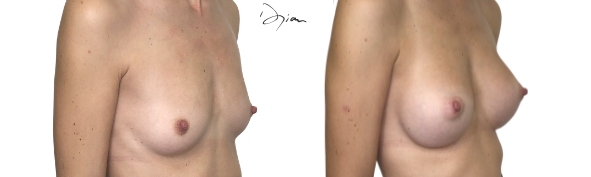
Breast Augmentation with Implants Performed by Dr. Djian
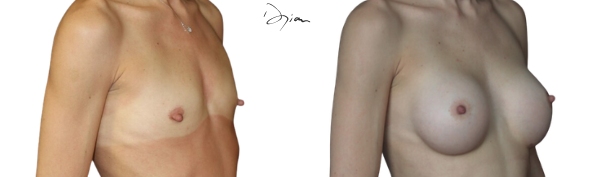
Breast Augmentation with Implants (Breast Agenesis)
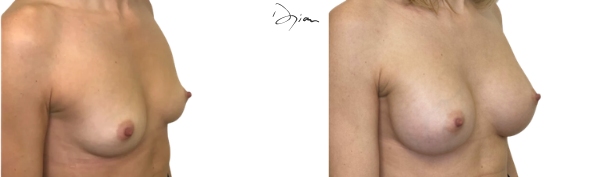
Breast Augmentation with Implants Performed by Dr. Djian
RISKS, COMPLICATIONS, AND SAFETY OF BREAST SURGERY
CAPSULAR CONTRACTURE: WHAT IS IT AND HOW CAN IT BE PREVENTED?
Any breast surgery involving implants can lead to the formation of a capsular shell. This is a natural reaction of the body: the body forms a fibrous sheath surrounding the implant (the capsule).
In some cases, this capsule shrinks and hardens; this is referred to as capsular contracture. According to Baker's classification, grades III and IV (hardened, painful, or deformed breast) require surgical treatment.
IMPLANT FAILURE: SIGNS, RISKS, AND TREATMENT
La rupture d’un implant mammaire en gel de silicone cohésif est dite « silencieuse ». L’enveloppe se fissure, mais le gel reste en place grâce à sa cohésion. La patiente ne ressent souvent no symptoms. The diagnosis is made by a breast ultrasound or a MRI. Ces examens sont recommandés en cas de modification de la forme ou de la sensibilité du sein..
In the event of a confirmed breach, the breast implant removal and the replacement with a new implant is the standard procedure. Modern implants are more durable than previous generations, but fracture is still possible, particularly after direct trauma.
OTHER COMMON SIDE EFFECTS: INFECTION, PAIN, SENSITIVITY
Like any surgical procedure, implant placement can lead to minor complications :
- infection (treated with antibiotics),
- hematoma post-opératoire,
- modification temporaire de la nipple sensitivity
- or slight asymmetry results.
Ces effets secondaires sont généralement transitoires et résolutifs avec un suivi médical adapté. Un contrôle post-opératoire est systématiquement planifié à J+8, à 1 month, then to 3 months.
Ces rendez-vous permettent de s’assurer de la bonne évolution cicatricielle et du bon positionnement des implants.
IMPLANT LIFESPAN, MEDICAL FOLLOW-UP, AND REPLACEMENT
HOW LONG DO BREAST IMPLANTS LAST?
Next-generation implants do not have a fixed lifespan. They are replaced only in the event of complications (rupture, capsular contracture, infection) or a desire to change the size. Some patients keep their implants for several decades without any problems. For more information, visit the page dedicated to lifespan of breast implants. However, regular monitoring is strongly recommended in order to detect any abnormalities early on and take action if necessary.
BREASTFEEDING AND PREGNANCY AFTER BREAST AUGMENTATION: IS IT POSSIBLE?
Pregnancy after breast augmentation is entirely possible. Breastfeeding is also possible in most cases, although the outcome varies depending on the surgical technique and each patient’s body type.
However, hormonal changes and weight gain associated with pregnancy can lead to breast ptosis after childbirth. A revision procedure by breast lift in Paris This can then be considered once the family planning process is complete and weight has stabilized.
LONG-TERM MEDICAL FOLLOW-UP: MAMMOGRAM AND ANNUAL CHECKUP
Les patientes porteuses d’implants mammaires bénéficient d’un suivi radiologique, recommandé par la Haute Autorité de Santé. Mammograms can still be performed on patients with implants, provided the radiologist is informed of their presence. Additional views (using the Eklund technique) allow the implant to be excluded from the imaging field.
Breast Ultrasound is often the preferred first-line treatment for envelope integrity check. This regular follow-up does not slow down breast cancer screening and should be continued according to the usual preventive care schedule.
PRICES, COVERAGE, AND CONSULTATIONS IN PARIS
HOW MUCH DOES A BREAST AUGMENTATION WITH IMPLANTS COST?
| Augmentation mammaire avec prothèses | Cosmetic surgery incl. VATfrom 6,000 euros | Reconstructive surgery incl. VATà partir de 4 000 euros |
The cost of breast augmentation par implant au cabinet du Dr Djian débute à partir de 6 000 € en chirurgie esthétique.
Ce tarif inclut des implants Motiva de dernière génération, une technique opératoire précise (dual plan) et un suivi post-opératoire personnalisé assuré directement par le Dr Djian.
Dans le cadre d’une chirurgie réparatrice (reconstruction mammaire, malformation, asymétrie sévère), le tarif démarre à partir de 4 000 €.
This amount includes the surgeon's fees, the clinic fees, the anaesthetist's fees, the cost of implants and postoperative follow-up visits. A personalized and detailed estimate is provided during the preoperative consultation, in accordance with current regulations.
HEALTH INSURANCE COVERAGE: IN WHAT CASES?
Breast augmentation performed for reasons purely aesthetic is not covered by health insurance. A breast augmentation management However, it remains possible when the procedure is performed for a medical indication recognized by Social Security. The situations that may be accepted (though not automatically) are as follows:
- breast reconstruction after breast cancer (total or partial removal),
- agenesis or severe breast hypoplasia (undeveloped breasts or smaller than an A cup),
- tuberous breasts (tubular appearance and enlarged areoles),
- Poland syndrome,
- significant breast asymmetry,
- congenital malformation severe.
In these cases, a request for prior agreement est déposée auprès de la Caisse d’Assurance Maladie par le chirurgien plasticien. Si elle est acceptée, l’Assurance Maladie prend en charge les frais d’hospitalisation. Le Dr Djian rédige cette demande directement lors de la consultation, en fonction de la malformation diagnostiquée. Il vous informe ensuite de votre éligibilité.
Your health insurance plan may provide additional coverage. In cases of a confirmed breast malformation, use the code QEMA004 de la Sécurité sociale pour interroger votre mutuelle sur les remboursements complémentaires prévus par votre contrat.
MAKE AN APPOINTMENT WITH DR. DJIAN IN PARIS
Choosing a surgeon for breast augmentation is, above all, a matter of trust. Beyond technical skills, the rapport between the patient and her surgeon is crucial: it determines the quality of communication, the surgeon’s understanding of the patient’s goals, and the patient’s peace of mind throughout the entire treatment process.
Le Dr Jérémy Djian attache une importance particulière à chaque étape de votre prise en charge. Cela va de l’écoute de votre désir au choix précis des implants, en passant par la finesse des gestes chirurgicaux et le post-operative follow-up. Cette exigence du détail est au cœur de sa pratique.
Lors de votre première consultation au cabinet du 16ᵉ arrondissement de Paris, vous bénéficiez d’un bilan personnalisé, d’une information médicale complète et d’un devis transparent. Cette consultation ne vous engage à rien.
Programmer votre rendez-vous.
Contact Dr. Djian's office
Your Questions
FREQUENTLY ASKED QUESTIONS ABOUT BREAST AUGMENTATION WITH IMPLANTS
How do you choose a surgeon for breast augmentation in Paris?


Choosing a surgeon is the most critical step in planning a breast augmentation. Make sure the surgeon is certified by the Residency in Reconstructive and Cosmetic Plastic Surgery and that he works at a approved facility. Au-delà des qualifications, la qualité de la relation lors de la consultation est primordiale. Un bon chirurgien prend le temps d’écouter votre projet, d’évaluer votre morphologie et de vous expliquer les options réalistes.
Le Dr Djian reçoit en consultation à Paris 16. Prenez rendez-vous pour évaluer votre projet ensemble.
What is the difference between breast augmentation with implants and lipofilling?
- Thebreast augmentation by prosthesis consiste à poser un implant en gel de silicone pour augmenter le volume de 1 à 3 bonnets. Le résultat est immédiat et durable.
- Breast lipofilling, on the other hand, uses your own fat harvested through liposuction to increase the size slightly (usually by ½ to 1 cup size).
- Thecomposite breast augmentation combines both techniques for very thin patients who want a natural-looking result with optimal coverage of the implant.
The choice between these options depends on your expectations, your body type, and your available fat reserves.
What is the difference between breast augmentation and a breast lift?
- Thebreast augmentation by prosthesis ajoute du volume à une poitrine jugée trop petite.
- The breast lift (mastopexy), lui, repositionne et raffermit des seins qui ont perdu leur tonus ou qui tombent (ptose). Il n’a pas nécessairement pour but d’en augmenter le volume.
Dans certains cas, les deux interventions sont combinées : on augmente le volume avec une prothèse tout en corrigeant la ptose.
At what age can you get breast implants?
Cosmetic breast augmentation is performed ages 18 and ups, âge de la majorité légale et de la the usual end of breast development.
Il n’existe pas d’âge maximum : l’intervention peut être envisagée à tout âge, sous réserve d’un bilan de santé favorable.
Dans des cas médicaux spécifiques (hypotrophie sévère, malformation), une intervention peut exceptionnellement être discutée avant 18 ans. Elle nécessite alors un accord parental obligatoire et la réalisation de 2 consultations préopératoires.
Are the results of breast augmentation with implants permanent?
Les implants mammaires de nouvelle génération ne nécessitent pas d’être remplacés à échéance fixe : certaines patientes les conservent plusieurs décennies sans complication.
Le résultat visuel, lui, peut évoluer dans le temps. Trois facteurs peuvent l’influencer :
- la grossesse,
- des variations de poids importantes,
- ou le vieillissement naturel des tissus.
Un suivi régulier permet de s’assurer du bon état des implants et d’anticiper tout remplacement si nécessaire.
Can you feel or see breast implants under the skin?
When installed in dual-plane technique (implant placed partially under the muscle), the risk of the implant being felt is greatly reduced, especially in slender patients. When placed in the prepectoral position, the implant is more noticeable in patients with little breast tissue.
Can you go swimming or go to the pool after breast augmentation surgery?
Any immersion (in a pool, the ocean, or a bath) is not recommended during the first month after surgery, to protect the scars from the risk of infection and excessive moisture. The Showering is generally allowed starting in the first few days after surgery. Once the wound has fully healed, there are no contraindications to swimming. The Saunas and steam rooms should also be avoided during the first month.
Can you go out in the sun and tan after getting dental implants?
The sun does not damage the implants themselves, but it poses a risk to scars : Exposure without protection during the first year can lead to a long-lasting hyperpigmentation. It is recommended to apply a SPF 50 sunscreen on scars and to keep them covered as much as possible for 12 months. Going topless is possible once the scars have healed, provided you follow these precautions.
Can you fly after breast augmentation surgery?
Implants are not affected by cabin pressure: the fear that prostheses might «burst» on an airplane is unfounded. However, air travel itself imposes certain postoperative restrictions that must be followed. The Prolonged sitting increases the risk of phlebitis in the weeks following any surgery, and the upper-body movements (luggage, narrow aisles) put strain on the areas that were operated on. For these reasons, short-haul flights are not recommended during the first 15 days, and long-haul flights should be avoided for 4 to 6 weeks. If travel is unavoidable, discuss this with Dr. Djian, who can adjust the recommendations and, if necessary, prescribe preventive anticoagulant therapy.
Does weight gain or loss affect breast implants?
Les implants eux-mêmes ne sont pas affectés par les variations de poids. En revanche, les tissus qui les entourent peuvent évoluer.
A weight gain importante augmente le tissu graisseux autour des prothèses et peut modifier l’aspect de la poitrine.
À l’inverse, un amaigrissement significatif peut réduire la couverture naturelle et rendre les contours de l’implant plus perceptibles.
Il est conseillé d’avoir atteint un stable weight avant l’intervention pour optimiser la sustainability of results.
Is there a risk of breast implant rejection?
The silicone breast implants are not rejected by the body in the immunological sense. The body naturally forms a fibrous capsule around any foreign body, which is a normal and expected phenomenon. In some cases, this capsule may contract abnormally (capsular contracture) and require surgical treatment. This risk is minimized by choosing next-generation implants and an appropriate surgical technique.
Can you drive right away after breast augmentation surgery?
Driving is generally not recommended during the first 15 days suivant l’opération, en raison de la gêne fonctionnelle des bras et des épaules liée à la technique dual plan.
A emergency braking or a sudden movement of the steering wheel peut être douloureux dans les premiers jours.
La reprise de la conduite dépend de l’évolution de la douleur and mobilité de chaque patiente. Elle est discutée lors du contrôle postopératoire à J+8.
Can you have breast augmentation surgery if you have a family history of breast cancer?
Des antécédents familiaux de cancer du sein ne constituent pas une contre-indication absolue à une augmentation mammaire.
Cependant, un A thorough preoperative evaluation is essential, incluant une mammographie et/ou une échographie mammaire.
La pose d’implants n’augmente pas le risque de développer un cancer du sein. Le suivi radiologique de dépistage reste par ailleurs tout à fait réalisable avec des implants.
Une consultation avec un chirurgien et un avis oncologique peuvent être recommandés selon votre situation personnelle.
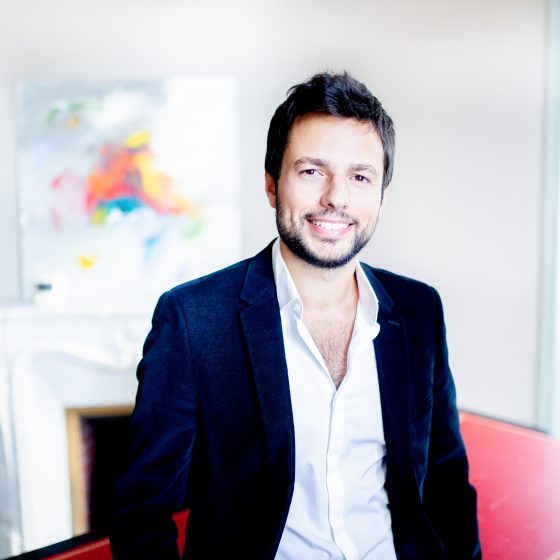
Dr Jérémy Djian is a plastic surgeon based at 5 square Thiers, near the Victor Hugo roundabout, in the 16th arrondissement of Paris.
He trained in Paris and worked on the team of Professor Laurent Lantieri, a leading authority on face transplant surgery.
YOU MAY BE INTERESTED
IN THESE SECTIONS

TO DR. DJIAN